
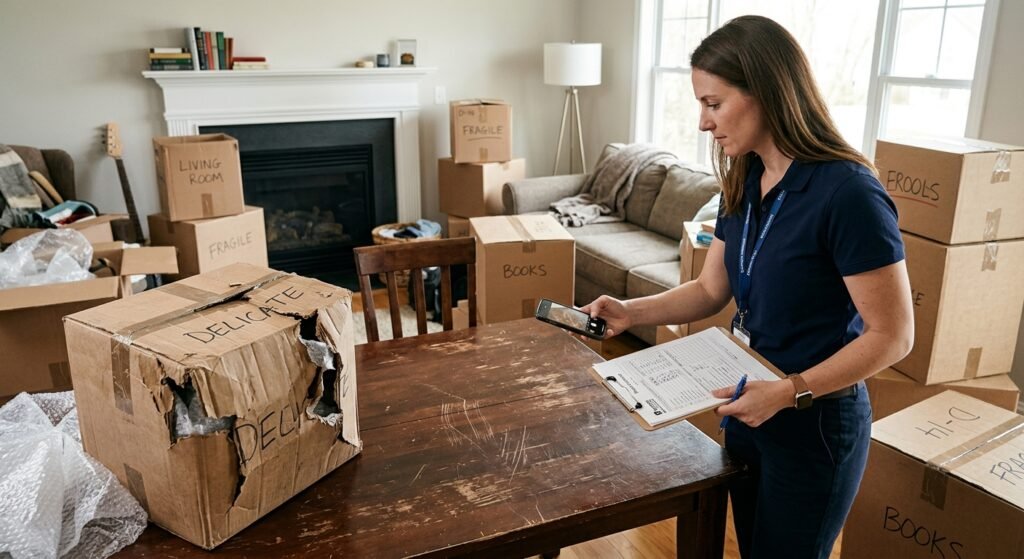
When your belongings arrive scratched, broken, or missing, the mover will look at one thing before they decide what to offer you: your claim file. A well‑built file can turn a frustrating experience into a documented dispute that is harder to ignore or underpay.
Most people only move a few times in their lives, but moving companies and their claims departments handle files every single day. They know when a claim is thin, disorganized, or unsupported. This guide is designed to help you level that playing field by showing you exactly how to build a strong moving damage claim file from day one.
Here you will learn how to collect the right photos and videos, organize your bill of lading and inventory pages, document loss values, use repair and replacement estimates, and respond when the carrier makes a low offer or tries to deny liability. We will also walk through timelines, depreciation basics, and when it may be appropriate to escalate to arbitration, a government complaint, or legal advice.
This is general information for U.S. consumers dealing with household‑goods moves. Rules can differ between interstate and in‑state moves, local jobs, military or corporate relocations, and international shipments. Always review your own bill of lading, tariff, valuation election, and carrier claim form for specific terms and deadlines.
Key takeaways
- Your moving damage claim file is more than a form; it is a package of documents, photos, and explanations that supports each dollar you request.
- Start collecting evidence at delivery: note exceptions on the delivery receipt, take photos before unpacking everything, and save every piece of paperwork.
- Keep your documents organized by sections (paperwork, photos, estimates, receipts, correspondence) so you can respond quickly when the carrier asks questions.
- Learn how your valuation election (full value protection vs. released value) limits what you can recover and how to calculate your claimed amount within those limits.
- Use written repair estimates, replacement links, and depreciation calculations to show how you arrived at your claimed numbers.
- Be ready for the mover to push back with arguments about pre‑existing damage, packing, or coverage and prepare counter‑evidence in your file.
- If you cannot resolve the dispute, your organized claim file will be critical for arbitration, a government complaint, or a legal review.
Why your claim file matters so much
Many consumers believe that describing what happened in a short email is enough to recover money from a moving company. In reality, household‑goods carriers expect a structured claim file that looks similar to what an insurance adjuster would build.
Your file is important because:
- It shows you met written claim requirements and deadlines.
- It backs up your version of events with documents and visuals.
- It makes it harder for the mover to dismiss your complaint as “emotional” or “unsupported.”
- It gives any third party (arbitrator, court, or state agency) a clear, chronological story of what happened and what you did to fix it.
How movers evaluate files
When a claim hits a mover’s desk, the reviewer will quickly look for certain things:
- Is the claim timely under the bill of lading and tariff?
- Does the inventory show the item loaded and not excluded?
- Was there any notation of damage at pickup or delivery?
- Do photos clearly show the damage or missing area?
- Does the claimed amount match the valuation coverage?
If these items are missing or unclear, the company has more room to delay, deny, or make a low offer. A detailed moving damage claim file closes those gaps.
Understanding claim rules and deadlines
Before you build your file, you need to understand the basic claim rules that apply to your move. The rules can differ based on whether your move was:
- Interstate (between states, typically regulated by federal law and FMCSA)
- Intrastate (within one state, often regulated by state law and a state agency)
- Local hourly move (short distance, usually under a state or contract framework)
- Military or corporate relocation (special programs and contracts)
Key places to find your deadlines
Look in these documents for claim deadlines and procedures:
- Bill of lading (the main contract for transport)
- Tariff or terms and conditions (sometimes provided as a booklet or link)
- Valuation or protection plan description
- Claim form or claim instructions from the mover or its claims company
For many interstate household‑goods moves, carriers often require that you submit a written claim within a certain number of months after delivery. Federal regulations such as 49 CFR Part 370 address claims processing for carriers in interstate commerce, but your specific timelines will be in your paperwork.
If your move was within one state, state law or a public utilities commission rule may set other deadlines. When in doubt, submit your written claim as soon as possible and keep proof of sending.
Timeline overview
| Stage | Typical timeframe (example only) | What to do for your claim file |
|---|---|---|
| Delivery day | Same day | Note visible damage/shortages on delivery receipt, start photos and videos. |
| First week after delivery | Days 1–7 | Finish unpacking, list all issues, gather serial numbers and receipts, request estimates. |
| Claim submission | Within your contract deadline | Submit written claim with itemized list, values, and supporting evidence. |
| Carrier review | Weeks to months depending on rules | Respond to requests for extra documents or photos, keep all correspondence. |
This table is an example only. Always verify your own deadlines in your paperwork and applicable law.
Core documents every claim file needs
Your moving damage claim file should start with the paperwork that created the relationship in the first place: your contract and related documents. Keep digital scans and paper copies if possible.
Essential paperwork to include
- Bill of lading – Shows the carrier, dates, origin/destination, and basic contract terms.
- Order for service / estimate – Summarizes services, expected charges, and binding vs. non‑binding nature of the estimate.
- Valuation election form – Indicates whether you chose full value protection, a deductible, or released value (often 60 cents per pound for interstate moves).
- Household goods inventory pages – Itemized list of cartons and pieces, with condition codes and notations.
- Pickup and delivery receipts – Signed documents at origin and destination, including any damage or shortage notes.
- Tariff or terms and conditions – May be a booklet or link that explains claim procedures, time limits, and limitations of liability.
- Emails and texts with the mover – Especially any messages where issues, promises, or agreements are discussed.
- Invoices and payment receipts – Prove what you paid and that this shipment was completed.
Why these documents matter
These documents help prove that the mover actually handled the item that is now damaged or missing, that it was part of the shipment, and what obligations the mover took on. They also show your valuation choice, which directly affects the maximum amount the company may be responsible for under the contract.
Without them, you leave room for arguments such as:
- The item was never tendered to the mover.
- The item was already damaged before pickup.
- You chose a low valuation level that restricts recovery.
- You missed required claim deadlines.
Photos, video, and visual evidence
Clear photos and videos are some of the strongest elements in a moving damage claim file. They can show not just that an item is broken, but also how it was packed, where it sat in the home or truck, and whether there were signs of mishandling.
What to photograph
- The entire item from multiple angles.
- Close‑ups of scratches, dents, tears, or broken parts.
- Packing materials around the item (crushed boxes, torn wrapping, missing padding).
- The area where the item was located if relevant (e.g., gouged floors, dented doorways).
- Any cartons that arrived opened, crushed, wet, or resealed.
- Labels or inventory stickers tied to that item or carton.
How to label and store photo evidence
Use simple file names and folders so you can quickly find images when the claims department asks for more information.
| Photo name example | What it shows | Folder suggestion |
|---|---|---|
| 2024-08-17_dining-table_overview.jpg | Full view of damaged table | /Photos/Dining table/ |
| 2024-08-17_dining-table_deep-scratch-closeup.jpg | Close‑up of scratch with ruler for scale | /Photos/Dining table/ |
| 2024-08-17_carton-23_crushed-corner.jpg | Crushed moving carton that held damaged dishes | /Photos/Cartons/ |
If you have pre‑move photos or a home inventory for insurance, keep those with your file as well to show the prior condition of high‑value items.
Sample wording to describe photo evidence
“Attached Photos 1–4 show the dining table (Inventory #45) immediately after delivery on June 3. The deep scratch across the top was not present before pickup, and the surrounding packing materials show inadequate padding on the table surface.”
Using inventory sheets and condition codes
The household goods inventory is one of the most important and misunderstood documents in a moving damage claim file. It lists the items or cartons loaded, often with brief descriptions and condition codes at origin.
Typical inventory elements
- Carton numbers and furniture tag numbers.
- Room of origin, such as “LR” for living room.
- Very short description (e.g., “Table wood,” “Sofa 3‑cushion”).
- Condition codes like “SC” (scratched), “D” (dented), or letters and numbers that are explained on the form.
- Columns for origin conditions and destination exceptions.
Using the inventory to support your file
When an item is damaged, look at:
- Whether it appears on the inventory at all.
- What condition codes were checked at pickup.
- Whether you or your representative signed the inventory at origin or delivery.
If the mover tries to deny your claim as “pre‑existing damage,” compare their condition codes with your photos. Sometimes codes are overused or do not match reality.
Inventory vs. condition: example table
| Item / Carton | Inventory notes | How to use in claim file |
|---|---|---|
| Dining table (Tag 45) | “Table wood” – no condition codes marked | Supports argument that table was listed and not noted as scratched at origin. |
| Carton 23 (Kitchen) | “Dishes” – packed by carrier (PBO/CP) | Helps show mover’s packing responsibility for broken dishes. |
| Sofa (Tag 12) | Condition code “SC” for minor scratches | Use photos to argue that new large tear is different from minor pre‑existing scratches. |
How to value damaged and missing items
A strong moving damage claim file does not just say that something is broken; it clearly explains the dollar amount requested and how you calculated it within your valuation coverage.
Know your valuation coverage
For many interstate moves, you may have chosen between:
- Full value protection (FVP) – Carrier agrees to repair, replace with similar item, or make a cash settlement up to the declared value, subject to conditions and possible deductibles.
- Released value (e.g., 60 cents per pound per article) – Very limited carrier liability based on weight only, not actual value.
Your valuation form or bill of lading should spell out what you chose. If you are not sure, include a copy in your file and highlight the relevant section.
Types of losses to value
- Items that are completely destroyed and not repairable.
- Items that can be repaired, with cost estimates.
- Missing items that never arrived or are significantly short.
- Partial sets (e.g., 3 missing glasses from a set of 8) and how that affects value.
Valuation example table
| Item | Supporting evidence | Claimed amount (subject to valuation) |
|---|---|---|
| Solid wood dining table (Tag 45) | Original receipt from 2018 ($1,200), online replacement links, repair estimate for refinishing ($450) | $450 (repair cost) or replacement cost less depreciation, depending on coverage |
| Television 55″ (Carton 10) | Serial number, purchase receipt from 2021, photo of cracked screen, repair shop statement that damage is not economical to repair | Replacement cost of similar TV, adjusted by depreciation if applicable |
| Missing box of clothing (Carton 37) | Inventory listing, photos of similar items, approximate itemized list of contents with estimated original prices | Reasonable replacement value for clothing, subject to any per‑pound limit |
Sample valuation wording
“For the dining table (Inventory #45), I am claiming the $450 repair estimate from ABC Furniture Repair dated July 2, 2024. Alternatively, if repair is not selected, a comparable replacement table currently retails for approximately $1,400 before tax, as shown in the attached price printouts.”
Depreciation basics and examples
Carriers and their claims vendors often apply depreciation when calculating settlements, especially for non‑repairable items and when your valuation terms allow cash settlements. Depreciation is a reduction in value over time due to age and use.
General factors
- Age of the item at the time of loss.
- Expected useful life (for example, electronics often have shorter lives than solid wood furniture).
- Condition before the move (new, good, fair, poor).
- Market changes (obsolescence, newer models).
Your mover may have its own internal depreciation tables. You can still present a reasonable estimate of actual cash value by combining the original cost, age, and common‑sense useful life.
Example: simple depreciation scenarios
| Item | Original cost & age | Illustrative value discussion |
|---|---|---|
| Sofa | $1,000, 5 years old | If typical life is 10 years, some carriers might treat it as about 50% depreciated, suggesting an actual cash value around $500. |
| TV | $800, 3 years old | Electronics may be treated as shorter‑life items; a carrier might argue a value around 50–60% of original cost depending on condition and technology changes. |
| Solid wood dresser | $600, 8 years old | If well maintained and with a long expected life, depreciation might be modest; you can argue a higher remaining value based on quality. |
These are simple illustrations, not fixed rules. Your carrier may use different assumptions. In your file, clearly state the age, original cost, and current comparable prices to support your position.
How to organize your moving damage claim file
A strong claim file is not only complete but also easy for others to review. When an adjuster, arbitrator, or consumer agency can quickly navigate your materials, it becomes much simpler for them to understand your side of the story.
Suggested digital folder structure
- 01_Contract_and_paperwork
- 02_Inventory_and_condition
- 03_Photos_and_videos
- 04_Estimates_and_receipts
- 05_Claim_form_and_letter
- 06_Correspondence_with_mover
- 07_Escalation_documents (complaints, arbitration filings, etc.)
Within each folder, use clear file names with dates and short descriptions. Maintain a separate index document listing each item in your file and where it can be found.
Paper file tips
- Use a binder with tabbed dividers for each section.
- Keep a printed copy of your claim form and all attachments.
- Staple or clip related estimates and photos together.
- Store all original receipts in protective sleeves.
Good organization makes it easier to respond promptly when the mover asks for more detail, which can prevent delays and keep your claim within required timelines.
Drafting a clear claim letter or form
Most movers will provide a claim form, often from a third‑party claims company. Whether you use their form or submit a letter that meets the written‑claim requirements, clarity is critical.
Key elements of a strong claim letter
- Your full name and contact information.
- Move details: carrier name, order number, pickup and delivery dates, origin and destination cities/states.
- Reference to the bill of lading number.
- A clear statement that this is a written claim for loss and/or damage.
- An itemized list of each damaged or missing article with claimed amounts.
- A brief description of what happened (optional but often helpful).
- Mention of attached photos, estimates, inventories, and receipts.
Sample claim letter wording
“This letter constitutes my formal written claim for loss and damage related to my household goods shipment transported by [Carrier Name], Bill of Lading #123456, from Austin, TX to Raleigh, NC, with delivery on May 10, 2024.
Attached is an itemized list of damaged and missing items, including the dining table (Inventory #45), 55″ television (Carton 10), and missing clothing carton (Carton 37). For each item, I have included photos, copies of purchase receipts when available, repair estimates, and online pricing for comparable replacements.
Please confirm receipt of this claim and advise if you require any additional documentation under the applicable tariff or claim procedures.”
Send your claim via a method that provides proof of delivery, such as email with read receipt, certified mail, or through the mover’s secure claim portal.
How movers and adjusters may respond
Once your claim is submitted, the carrier or its claims company will review the file. Their responses can vary, but they typically fall into a few patterns.
Common types of responses
- Request for more information or documentation (extra photos, receipts, or proof of ownership).
- Questions about packing responsibility (who packed which carton).
- Denial based on alleged pre‑existing damage or packing issues.
- Settlement offer for less than the claimed amount, often citing valuation limits or depreciation.
Document every phone call in a written log with dates, names, and summaries of what was said. Confirm important points by email when possible so you have a record for your file.
Example: how to log a phone call
“June 12, 2024 – 10:30 a.m. – Spoke with Sarah in claims at [Carrier Name]. She requested a closer photo of the TV serial number and an updated repair estimate for the dining table. She stated they would review the file within 10 business days after receiving these items.”
Responding to low or unfair settlement offers
If the mover offers far less than you believe is fair, you do not have to accept immediately. A well‑organized moving damage claim file gives you the ability to push back respectfully and specifically.
Compare offer to your coverage and evidence
- Check whether the settlement correctly applies your valuation choice (full value vs. released value).
- Review weight calculations if the carrier is using per‑pound liability.
- Verify depreciation assumptions against age and condition.
- See if any items were omitted or undercounted.
Sample response to a low offer
“Thank you for your settlement offer dated August 5, 2024. I appreciate your review; however, I disagree with the proposed amounts for the dining table (Inventory #45) and the missing clothing carton (Carton 37).
For the dining table, your offer of $150 appears to apply a high level of depreciation and does not reflect the attached $450 professional repair estimate. The table is a solid wood piece purchased in 2018 and in good condition before the move, as shown in my pre‑move photos. I respectfully request that you reconsider this item based on the documented repair cost.
For Carton 37, your valuation appears to be based on 60 cents per pound, but my paperwork shows that I selected full value protection. I have attached another copy of the valuation election form and request that you review this portion of the file.”
Common claim‑file mistakes to avoid
Some mistakes make it much easier for a carrier to deny or minimize your claim. Being aware of them helps you build a cleaner, more persuasive file.
Frequent pitfalls
- Waiting too long to submit a written claim.
- Relying on phone calls instead of written documentation.
- Sending photos in random, unlabeled batches.
- Not connecting each claimed item to the inventory and paperwork.
- Accepting a low offer without asking for an explanation.
Mistake vs. countermeasure table
| Common mistake | Why it hurts your claim | Better approach |
|---|---|---|
| Only calling the mover to complain | No official written claim on record, making it harder to enforce deadlines or rights. | Submit a clear written claim letter or form and keep proof of sending. |
| Throwing away boxes and packing before taking photos | Loses evidence of poor packing or mishandling. | Photograph damaged cartons and materials before disposal. |
| Accepting cash for damage on delivery without reading | You might be signing a release that limits future claims. | Read any form carefully and avoid signing broad releases without understanding them. |
When and how to escalate your dispute
If you cannot reach a reasonable resolution directly with the mover or its claims company, your organized file becomes the foundation for escalation. Options can include:
- Company internal escalation to a supervisor or customer‑relations department.
- Arbitration program (often required for certain interstate loss and damage disputes).
- Federal or state consumer complaints.
- Small claims court or other legal options, after you obtain legal advice.
Arbitration
For many interstate household‑goods shipments, carriers must participate in an arbitration program for some types of disputes, especially over loss and damage and some billing issues. Your bill of lading or tariff should explain whether arbitration is available, what it covers, and how to start the process.
Complaints to agencies
- FMCSA National Consumer Complaint Database for interstate movers.
- State public utilities commission or consumer protection office for intrastate movers, when applicable.
These complaints may not directly decide your claim, but they can put pressure on the mover to respond and help agencies track patterns of behavior.
Legal review
If the dollar amount is high or the issues are complex, you may want to speak with an attorney experienced in transportation or consumer law. Your detailed claim file will help that attorney understand what happened and evaluate potential options.
What not to sign or say too early
Under stress, it is easy to sign or say things that later limit your options. Caution here is an important part of building a strong file.
Be careful with:
- Delivery receipts that state “received in good condition” if you already see damage or shortages.
- Any document labeled “release,” “waiver,” or “full and final settlement” before you understand the scope of damage.
- Informal promises like “We won’t file a claim if you give us a discount” that are not in your best interest.
On the delivery receipt, if you see obvious problems, note them clearly, for example:
“Sofa torn, TV carton crushed, 1 box clothing missing – subject to further inspection.”
This does not replace a formal written claim, but it supports your position that issues existed at delivery.
Quick checklists for a strong file
Delivery‑day documentation checklist
- Take wide and close‑up photos of any visible damage.
- Note problems on the delivery receipt before signing.
- Keep copies of all paperwork the crew asks you to sign.
- Ask the crew to identify any missing cartons by number if they know.
- Save damaged boxes and packing until you can photograph them.
First‑week claim‑file checklist
- Create digital folders for your documents, photos, and estimates.
- Finish unpacking and list all damaged or missing items.
- Match each item to the inventory page and tag number when possible.
- Collect receipts, serial numbers, and purchase dates.
- Schedule repair estimates for major items.
Claim submission checklist
- Confirm the written claim deadline in your paperwork.
- Complete the mover’s claim form or a detailed claim letter.
- Attach your itemized list, photos, estimates, and key documents.
- Send the claim in a way that provides proof of delivery.
- Start a log for all phone calls and emails with the mover.
Escalation readiness checklist
- Keep copies of all settlement offers and your responses.
- Organize your file by sections with an index.
- Print or save PDFs of email threads.
- Gather information about any arbitration program offered.
- Research FMCSA and state complaint options if needed.
Frequently asked questions
How fast should I start building my moving damage claim file?
Begin on delivery day. Take photos before the crew leaves when possible, note visible problems on the delivery receipt, and start a list of damaged or missing items. The sooner you organize evidence, the easier it is to meet any written claim deadlines in your bill of lading.
Do I need original receipts for everything I claim?
Original receipts are helpful but not always required. For many items, you can use bank or credit‑card records, order confirmations, warranty registrations, or realistic price examples from reputable retailers. Note approximate purchase dates and prices if you no longer have receipts.
What if the mover says the damage was pre‑existing?
Compare their claim to your inventory, pre‑move photos (if you have them), and the condition codes at origin. If the item had no damage noted at pickup and your photos show a clear new problem, highlight that in your letters. Include side‑by‑side comparisons in your file when possible.
Should I throw away broken items after I take photos?
Keep major damaged items, or at least the damaged parts, until your claim is resolved or the mover tells you in writing that they do not need to inspect them. For space reasons you may need to dispose of some items, but take thorough photos from multiple angles first.
Can I repair something before my claim is settled?
It is safer to wait for approval or at least written acknowledgment that you may proceed with repair while still claiming the cost. If health or safety requires immediate repair, document the situation carefully and keep all invoices. Let the mover know in writing what you plan to do.
What if I packed my own boxes?
Carriers often argue that they are not responsible for the internal contents of cartons you packed yourself, especially if there is no visible damage to the outer box. Still, document everything and file a claim if you believe handling or loading caused breakage. Show photos of crushed boxes or gaps in loading if available.
Is email enough to count as a written claim?
Often yes, if it clearly states that you are making a claim for specific loss or damage and includes necessary details. Some carriers require use of their specific claim forms, so check your tariff and instructions. In any case, keep copies and confirmations that your email was received.
How long will the mover take to respond to my claim?
Timeframes can vary and may be guided by federal or state rules, as well as your contract. Some carriers acknowledge receipt within a few days and issue a decision in several weeks, while others take longer. If there is no response, your organized file will help you follow up and escalate if necessary.
Can I go straight to court without filing a claim?
Many contracts and laws require that you submit a written claim and allow the carrier a chance to resolve it before pursuing other remedies. Skipping this step can hurt your position. If you are unsure of your options, consult a qualified attorney in your area.
What if my move was only within one state?
Intrastate moves are usually governed by state law and sometimes a state public utilities commission or transportation agency. Claim rules and liability limits may differ from interstate moves. Check your paperwork and consider contacting your state consumer‑protection office for guidance.
Official sources & further reading
- FMCSA Protect Your Move – Federal information for consumers planning interstate moves.
- FMCSA National Consumer Complaint Database – File complaints about interstate movers.
- 49 CFR Part 370 – Principles and Practices for the Investigation and Voluntary Disposition of Loss and Damage Claims – Federal regulation addressing carrier claims procedures.
- 49 CFR Part 375 – Transportation of Household Goods in Interstate Commerce – Federal regulation covering interstate household‑goods moves.
- Your state consumer protection agency or public utilities commission – Many provide guidance on intrastate household‑goods movers and complaint processes.
- Your bill of lading, tariff, and valuation documents – The primary sources for your specific claim deadlines and procedures.
Related guides
This guide is general information, not legal advice. For a specific dispute, consult a qualified attorney or your state consumer‑protection office.