
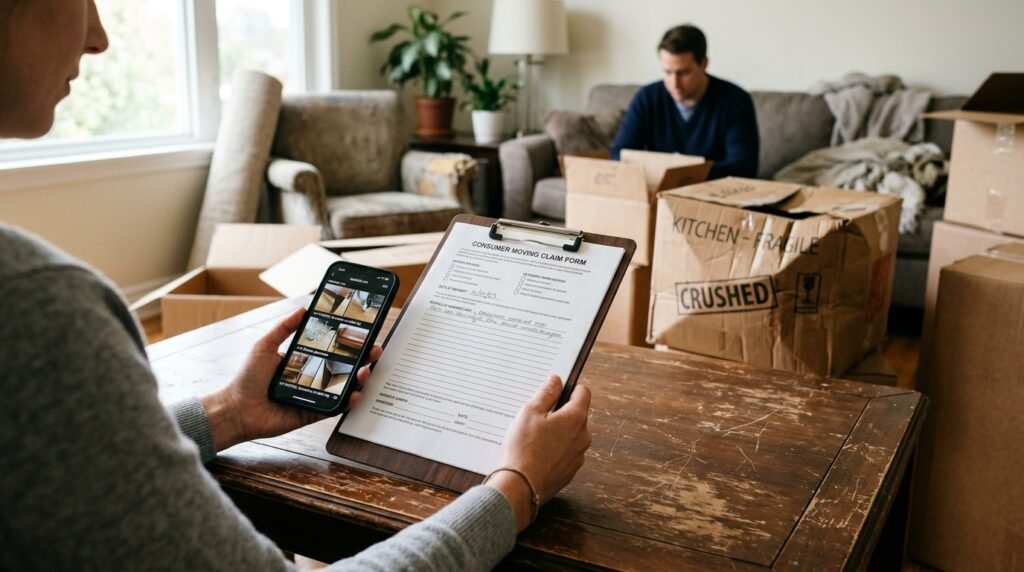
When your shipment finally arrives and you see gouged furniture, crushed boxes, or missing cartons, your first reaction is usually stress and anger. The mover may tell you to \”just file a claim,\” but they do not explain how to build a strong claim file that actually supports a fair settlement.
Carriers and their third-party adjusters rely heavily on what is in your file: photos, inventory pages, notes on the bill of lading, repair estimates, valuation elections, and your own written statement. Weak documentation often leads to tiny offers or denials. A well-built file, organized from day one, can dramatically improve your negotiating position even if it cannot guarantee a specific outcome.
This guide walks you through how to build a strong moving damage claim file step by step: what to document at delivery, which papers matter most, how to organize photos and repair estimates, how to calculate your claimed amount, and how to respond when the mover makes a low offer or delays your case. It focuses on U.S. household-goods moves and points you to official sources like FMCSA and federal regulations for further reading.
This is general information, not legal advice. Rules and deadlines can vary based on whether your move is interstate, intrastate, local, corporate, military, or international and on the specific language in your bill of lading and tariff. Always review your paperwork and consult a qualified professional if you need legal advice.
Key takeaways
- Your claim is only as strong as your documentation. Delivery-day notes, photos, inventories, and repair estimates carry more weight than verbal complaints.
- Keep every moving document: bill of lading, estimate, inventory, valuation election, and claim forms. They define deadlines, liability limits, and what the mover can argue later.
- Take clear, dated photos and videos showing each item before and after the move when possible, plus carton labels and room locations.
- Use written repair estimates, receipts, and replacement links to support the dollar amount you claim, and understand how depreciation and valuation reduce payouts.
- Organize your claim file in sections (documents, photos, estimates, correspondence) and keep a simple claim log with dates and contact names.
- Respond to low offers in writing, referencing your evidence and the mover’s own paperwork rather than arguing emotionally.
- Know your escalation options: company internal review, FMCSA complaint for interstate moves, arbitration, state agencies, or legal review if negotiations stall.
Why your claim file matters so much
Many consumers assume that when something arrives broken, the moving company will automatically pay for it. In reality, carriers look at your claim through the lens of liability limits, exclusions, and documentation. Your moving damage claim file is the structured bundle of evidence they review when deciding whether to pay, reduce, or deny your claim.
For interstate household-goods moves, federal rules such as 49 CFR Part 370 and 49 CFR Part 375 outline claim and liability procedures, but they still leave a lot of room for interpretation. Claims handlers rely heavily on what they can see in your paperwork and photos. If it is not in the file, they may act as if it did not happen.
A strong claim file helps you:
- Prove that the damage or loss occurred while the shipment was in the carrier’s custody.
- Show that the item existed and was in good condition before the move.
- Connect damaged items to inventory numbers and cartons.
- Establish the value of each item at the time of the loss.
- Demonstrate that you met deadlines and followed claim procedures.
- Prepare for escalation (arbitration, complaints, or court) if needed.
You cannot control how cooperative the mover will be, but you can control the quality and organization of your evidence. That is the purpose of this guide.
Core documents that make or break your file
Your documents form the backbone of your moving damage claim file. Before you do anything else, gather and secure every piece of paperwork related to your move. Do not rely on the mover to keep copies for you.
Essential documents to locate immediately
- Bill of lading (BOL) – the contract of carriage, often includes key terms, valuation, and liability.
- Order for service / written estimate – binding, non-binding, or not-to-exceed estimate plus services promised.
- Household goods inventory – numbered item list with condition notations at origin.
- Pickup and delivery receipts – including any exceptions or notations you signed.
- Valuation election / waiver forms – full value protection vs released rate and any special waivers.
- Tariff or terms and conditions – sometimes provided via link or brochure.
- Mover’s claim form and instructions – paper or online portal printouts.
- Emails and text messages with the mover – about damage, delays, or missing items.
Document importance comparison
| Document | What it proves | Why it matters for your claim |
|---|---|---|
| Bill of lading | Contract terms, carrier identity, dates, valuation level | Defines liability limits and deadlines the carrier may assert. |
| Household goods inventory | That the item existed, its condition at origin, carton numbers | Supports ownership and pre-move condition, counters \”pre-existing damage\” claims. |
| Valuation election form | Whether you chose full value protection or released rate | Sets the maximum the mover may owe per pound or per item. |
| Delivery receipt / exceptions | Immediate notations of visible damage or missing items at delivery | Helps show the problem existed when the mover still had control. |
Scan or photograph each document and keep digital backups in a secure folder. Rename files clearly (for example, \”2026-07-15_BOL.pdf\” or \”Inventory_Page3.jpg\”) so you can find them quickly.
Documenting problems at delivery
The delivery day is one of the most important moments for your claim file. What you do in those few hours can dramatically strengthen or weaken your case later.
Checklist: delivery-day actions for your claim file
- Be present or have a trusted adult authorized to act for you.
- As items come off the truck, note obvious damage or crushed cartons out loud and in writing.
- Ask that major damage or missing cartons be written on the delivery receipt before you sign.
- Photograph damaged items while movers are still present, including the truck and surroundings if relevant.
- Keep copies or photos of any documents you sign on site.
- Do not sign statements saying everything was delivered in \”good condition\” if that is not true.
If you discover concealed damage after the movers leave (for example, an internal crack in a TV or broken items inside boxes), document those items as soon as you notice them. Take photos, keep the packing materials, and notify the mover promptly in writing according to the claim instructions in your paperwork.
Using the inventory and check-off sheets
The household goods inventory is a key piece of evidence. Each item or carton typically has a tag number, description, and condition code. At delivery, the crew should check off each number as it comes into the home and note any missing tag numbers.
How to use the inventory to support your claim
- Match damaged items to their inventory numbers and descriptions.
- Compare the origin condition codes to the damage you now see. If an item was marked “good” or “OK” but arrives scratched or broken, that is helpful for your case.
- Identify missing items by tag number and inventory description.
- Highlight or circle problem items on a copy of the inventory to submit with your claim.
| Situation | Inventory clue | How to use it |
|---|---|---|
| Missing carton | Tag 42 \”Large carton – kitchen items\” not checked off at delivery | Cite tag 42 as undelivered, attach photo of inventory page highlighting that entry. |
| New scratches on dresser | Inventory line shows dresser with no damage codes or only minor wear noted | Argue that dresser was in better condition before transit; include before/after photos. |
| Damaged TV packed by movers | Inventory shows \”PBO\” (packed by owner) or \”CP\” (carrier packed) | If CP, you can argue the mover had packing responsibility; if PBO, liability arguments may differ. |
If you never received an inventory for a long-distance move, note that in your claim. Some intrastate or local moves do not use detailed inventories, but you can still rely on receipts, photos, and packing lists you created yourself.
Photos, video, and digital evidence
Images and videos are some of the most persuasive pieces of evidence in a moving damage file. Good visuals can counter arguments that the damage was \”minor\” or \”pre-existing\” or that the item was not worth what you claim.
Checklist: what to photograph
- Each damaged item from multiple angles, including close-ups and context shots.
- Serial numbers, labels, and model information where available.
- Carton labels and tag numbers for items that were boxed.
- Crushed or torn cartons and packing materials (do not discard too soon).
- Rooms or walls that were damaged during the move.
- Any unusual handling you witness (e.g., dropping boxes, dragging items).
Whenever possible, keep or recover any \”before\” photos showing items in good condition in your previous home. These could be listing photos, family pictures, or insurance inventory images. They do not have to be perfect; they just need to show the item existed and was not already destroyed.
| Evidence type | Best practices | Common problems to avoid |
|---|---|---|
| Photos | Use good lighting, include scale (hand or tape measure), show entire item and close-up damage. | Blurry shots, extreme zoom with no context, failing to show serial/model info. |
| Video walkthroughs | Narrate tag numbers and describe damage as you record each room. | Fast panning, no narration, long clips that are hard to share. |
| Screenshots/links | Capture product pages for replacement items with price and model visible. | Broken links, foreign equivalents that do not match your model or condition. |
Repair estimates and replacement documentation
Claims departments want to see objective evidence of what it will cost to repair or replace damaged items. That usually means repair estimates, receipts, or replacement price documentation.
Obtaining repair estimates
- For furniture, contact local furniture repair or refinishing shops for written estimates.
- For appliances and electronics, ask authorized service centers for diagnostic and repair quotes.
- For artwork or specialty items, look for niche restorers and request itemized proposals.
- Provide clear photos and descriptions so estimators can give realistic numbers.
Some movers have preferred vendors or may offer an inspection by their own third-party company. You can usually cooperate with that inspection while still gathering your own independent estimates.
Replacement documentation
- Collect purchase receipts, credit card statements, or order confirmations when available.
- If you do not have receipts, find current replacement items of similar kind and quality and save the URLs or print the pages.
- Note the brand, model, size, and materials to show you are not inflating value.
- Remember that if your valuation level allows depreciation, the adjuster may apply it to your claimed amount.
| Item | Evidence to collect | Why it helps |
|---|---|---|
| Sofa with torn fabric | Furniture repair estimate, photos of whole sofa, receipt if available. | Shows repair cost vs full replacement, supports negotiation on best remedy. |
| Broken TV screen | Service center estimate, screenshot of comparable TV model and price. | Shows whether repair is economical; supports replacement cost if not. |
| Chipped dining table | Refinishing quote, detail photos of chips and overall table. | Demonstrates that damage is more than \”minor wear\” and quantifies restoration cost. |
Valuation, liability, and how limits apply
Even a perfectly documented claim file is constrained by the liability limits you agreed to before the move. Understanding valuation helps you set realistic expectations and present your claimed amount in a way that fits within those limits.
Common valuation levels
Carrier liability on interstate household-goods moves is often governed by the federal Carmack Amendment and related regulations. The two broad categories you are likely to see are:
- Released rate valuation (often $0.60 per pound per article) – Lower cost upfront, but dramatically limits payouts. If a 100-pound dresser is destroyed, the maximum would typically be 100 x $0.60 = $60 regardless of its actual value.
- Full value protection (various deductible options) – More expensive, but the mover may be responsible to repair, replace, or pay the current market value (subject to limits and exclusions), often at a minimum per-pound shipment value.
Your bill of lading and valuation election form should show which option you chose and any declared shipment value, deductibles, or special terms. Some intrastate moves are governed by state-specific rules, tariffs, or public utilities commission regulations.
Valuation and depreciation example table
| Item | Scenario A: Released rate | Scenario B: Full value with depreciation |
|---|---|---|
| 150 lb sofa, purchased 5 years ago for $1,200 | 150 lb x $0.60 = $90 maximum, even if destroyed. | Current replacement $1,300; if adjuster applies, for example, 40% depreciation, they might value it at $780 (actual numbers vary). |
| 40 lb TV, purchased 2 years ago for $500 | 40 lb x $0.60 = $24 maximum. | Current replacement $400; if adjuster uses 30% depreciation, payout might be around $280. |
The depreciation percentages above are only examples. Carriers and arbitrators may use different schedules. The key for your claim file is to show purchase dates, original prices, and comparable current replacements so the adjuster cannot simply guess.
Calculating and presenting your claimed amount
Once you have identified all damaged and missing items and collected documentation, you can calculate your claimed amount. Claims departments appreciate clear, organized breakdowns rather than scattered numbers.
Steps to calculate your claimed amount
- Create a spreadsheet or table listing each item, inventory number, description, weight (if known), and your claimed dollar amount.
- For repairable items, use the repair estimate as your starting point.
- For non-repairable items, use replacement price minus reasonable depreciation if applicable under your valuation level.
- For missing cartons, list each item inside and provide replacement values or estimates.
- Double-check that your totals do not exceed any shipment-wide value you declared under full value protection.
Example wording in your claim: \”Based on the attached repair estimates and replacement price documentation, the total amount I am claiming is $3,245.75. A detailed itemization with references to inventory numbers and supporting documents is included as Exhibit A.\”
How to organize a strong claim file
Think of your claim file as a binder (physical or digital) that an outsider could pick up and understand within minutes. Disorganized evidence is easy to ignore; structured evidence is harder to dismiss.
Suggested claim file structure
- Section 1 – Summary and timelines
Short overview letter, list of key dates (pickup, delivery, first notice of damage, claim filed). - Section 2 – Core moving documents
Bill of lading, estimate, valuation election, tariff pages, inventories. - Section 3 – Itemized claim list
Table of items, inventory numbers, and claimed amounts. - Section 4 – Evidence
Photos, before/after comparisons, videos (with file names listed). - Section 5 – Repair and replacement support
Estimates, receipts, product pages, model information. - Section 6 – Correspondence log
Copies of emails, letters, and a simple log of phone calls.
Simple claim log example
| Date | Person & company | Summary of discussion or action |
|---|---|---|
| 2026-08-02 | Alex, ABC Movers claims dept. | Called to request claim form; Alex stated 9-month deadline and email submission address. |
| 2026-08-15 | Claims portal submission | Uploaded claim, 28 photos, and 3 repair estimates; confirmation #12345 received. |
Filing the claim: forms, timelines, and wording
Your paperwork, bill of lading, tariff, and mover’s claim instructions will usually state how and when to file. Many interstate carriers reference federal guidance suggesting that written claims should be filed within a certain period (commonly up to nine months for interstate shipments), but check your specific documents for exact deadlines.
Checklist: before you submit
- Confirm the claim filing address, email, or online portal.
- Review the written deadline in your documents and note it in your claim log.
- Ensure every claimed item has at least one piece of evidence attached.
- Number or label attachments (\”Photo 1 – Inventory #12 Dresser corner\” etc.).
- Save a full copy of everything you submit, including web forms (take screenshots).
Sample claim opening paragraph
\”I am submitting a formal claim regarding damages and losses to my household goods transported under Bill of Lading #123456 from Denver, CO to Raleigh, NC, picked up on May 2, 2026 and delivered on May 12, 2026. This claim is being filed within the timeframe stated in your written instructions and is accompanied by an itemized list of damages, supporting photographs, repair estimates, and copies of relevant moving documents.\”
How movers and adjusters typically respond
Once your claim is filed, it often moves to a claims department or a third-party administrator. Response timelines vary; some carriers acknowledge within days, while others may take weeks. Your bill of lading or tariff may contain general timeframes for disposition of claims, but they can differ by company and jurisdiction.
Typical stages of response
- Acknowledgment of receipt and assignment of a claim number.
- Request for additional information, photos, or estimates if needed.
- Possible inspection by a furniture or electronics technician.
- Initial settlement offer or denial.
- Appeal or reconsideration if you challenge the decision.
Keep communication polite and factual. Every email or letter you send is part of your claim file and may ultimately be reviewed by an arbitrator, regulator, or judge.
Countering low settlement offers
Low initial offers are common. Sometimes they are based on valuation limits and depreciation; other times they reflect incomplete information or aggressive adjusting tactics. Your job is to respond with clear references to your evidence and the mover’s own documents.
Table: low offer vs counter-strategy
| Mover/adjuster position | Risk if you accept at face value | Suggested counter-strategy |
|---|---|---|
| \”Item was previously damaged.\” | Payout reduced or denied due to alleged pre-existing damage. | Point to inventory condition codes and any \”before\” photos contradicting their claim. |
| \”We will only pay $0.60 per pound.\” | Severely limited recovery even if you purchased full value protection. | Review your valuation election; if it shows full value, quote the document language and ask them to explain how they calculated the offer. |
| \”We used our own depreciation schedule.\” | Depreciation may be harsher than what is reasonable for your items. | Provide purchase date, original price, and current comparable prices; ask them to justify the specific rate used. |
Sample response to a low offer
\”Thank you for your offer dated September 10, 2026. I respectfully decline this offer because it does not appear to reflect the valuation level elected on my bill of lading (full value protection) or the attached repair estimate for the dining table (Exhibit B). The inventory (Item #37) shows the table in good condition at origin, and the photos submitted with my claim clearly document the new damage. Please review the enclosed documentation and provide a revised offer that is consistent with the applicable valuation.\”
Common mistakes and how to avoid them
Even careful consumers can unintentionally weaken their claim. Being aware of frequent errors can help you avoid them.
Frequent claim file mistakes
- Throwing away packing materials or damaged items before taking photos.
- Failing to note damage on delivery receipts when it was visible.
- Missing claim filing deadlines stated in the bill of lading or tariff.
- Sending emotional, hostile emails instead of factual, organized responses.
- Accepting small \”quick offers\” or signing releases too early.
Mistakes and countermeasures table
| Common mistake | Impact on claim | How to avoid |
|---|---|---|
| No written claim, only phone complaints | Mover may argue no formal claim was ever filed. | Submit a clear written claim by email, portal, or mail and save proof of submission. |
| Inconsistent stories about what happened | Adjuster may question your credibility. | Create a short factual narrative early and stick to it. |
| Submitting incomplete evidence and \”hoping for the best\” | Weak basis for negotiation, easier for mover to deny or minimize. | Wait until you have photos and at least one estimate before filing, as long as you are within deadlines. |
Escalation: complaints, arbitration, and court
If negotiation stalls or you believe the carrier is not following its written procedures, you may consider escalation options. Which options are available depends on your type of move and your paperwork.
Possible escalation paths
- Internal reconsideration – Ask for a written review by a supervisor or a higher-level claims manager. Provide additional evidence or clarify misunderstandings.
- FMCSA complaints (interstate) – For interstate household-goods moves, you can file a complaint with the Federal Motor Carrier Safety Administration’s National Consumer Complaint Database. This does not decide your claim amount, but it may prompt carrier attention.
- Arbitration – Interstate movers must offer a neutral arbitration program for certain disputes. Check your bill of lading or mover’s brochure for details about procedures and fees.
- State consumer agencies (intrastate/local) – Many states regulate household-goods movers through a public utilities commission or consumer protection office, which may accept complaints.
- Small claims or other court actions – Some consumers seek legal remedies in court. This is a serious step and usually requires reviewing federal and state rules and, ideally, consulting an attorney.
Your well-organized claim file becomes crucial if you escalate. Arbitrators and judges often review exactly the same documents, photos, and timelines you have already prepared.
What not to sign or say too early
Under stress, consumers may sign away rights or make statements that later harm their case. Move day and the weeks after are when you must be especially cautious.
Be cautious with these documents
- Delivery receipts stating \”all items received in good condition\” when they are not. If a form forces that wording, insist that specific damage notes be written in the exceptions area before signing.
- Settlement releases that require you to waive all future claims in exchange for a payment you have not fully evaluated.
- Statements admitting fault, such as \”I packed everything poorly\” without context, especially where the mover provided packing services.
If you feel pressured, you can say: \”I am not comfortable signing this language today. I will sign to acknowledge delivery, but I will be filing a written claim for the damages we have discussed.\”
Sample wording for letters and emails
Clear, calm written communication helps your claim file. Use short paragraphs, specific references, and attach supporting documents whenever possible.
Initial notice of damage (short email)
Subject: Notice of damage – BOL #123456, Smith move Denver–Raleigh
Dear [Mover Name] Claims Department,
This email is to notify you that several items delivered on May 12, 2026 under Bill of Lading #123456 arrived damaged or missing. I am reviewing the shipment, documenting the issues, and will submit a formal written claim with photos and estimates within your stated deadline. Please confirm the correct email address or portal for claim submission and provide any required forms.
Sincerely,
[Your Name]
Follow-up when claim is delayed
Subject: Status request – claim #78910, Smith
Dear [Claims Representative],
I am writing to request a status update on my household-goods claim #78910 submitted on August 15, 2026, regarding my move under Bill of Lading #123456. I have not received a decision or additional information request since your acknowledgement on August 20, 2026. For your convenience, I have reattached the itemized claim list and summary letter. Please let me know when I can expect a written determination.
Thank you,
[Your Name]
Frequently asked questions
How long do I have to file a moving damage claim?
Deadlines depend on your bill of lading, tariff, and whether your move was interstate or intrastate. Many interstate carriers reference up to nine months for written claims, but you must check your specific documents and follow the written instructions provided by your mover.
Do I need an inspection for damaged furniture or electronics?
Some movers or their claims administrators may send an inspector or repair technician to look at damaged items. You can generally cooperate while also obtaining your own independent estimates. Keep inspection reports and technician notes in your claim file.
What if I already signed the delivery receipt as \”received in good condition\”?
You can still report concealed damage discovered after unpacking, especially if your paperwork allows concealed damage claims. Be honest about when you noticed the problems and provide strong photos and descriptions. The \”good condition\” statement may give the carrier an argument, but it does not automatically end your rights.
Can I throw away broken items after photographing them?
It is safer to keep severely damaged items and packing materials at least until your claim is resolved or inspected. If you must discard something, take multiple clear photos from different angles and note the date. Consider asking the mover or adjuster in writing whether they need to inspect before you dispose of anything major.
What if I do not have receipts for older items?
Receipts help but are not always required. Use reasonable estimates based on similar items sold today, and document brand, model, materials, and age. Online listings for comparable used or new items can help support your values.
Is the mover required to pay full replacement value for everything?
Not always. What they might owe depends on your valuation level, any declared shipment value, deductibles, and applicable law. Released rate plans can severely limit payments, and some full value plans apply depreciation or caps. Your bill of lading and valuation election form are critical for understanding these limits.
How long will it take to get a decision on my claim?
Timeframes vary by carrier and jurisdiction. Some companies aim to respond within a set number of days, while others may take longer, especially for complex files. Your tariff or terms may include general timelines. Keeping a claim log and sending polite written follow-ups can help keep things moving.
Should I accept a partial payment while I keep fighting for the rest?
Read any release or settlement documents carefully. Some offers are \”full and final,\” meaning you cannot pursue additional amounts later if you accept. Ask the claims representative to clarify in writing whether a payment is partial or final before you agree.
Do I need a lawyer to handle my moving claim?
Many consumers handle claims themselves, especially for smaller amounts. However, if the dispute is complex, high-value, or headed toward court, consulting an attorney who understands household-goods carrier liability and state law can be helpful. This guide is not a substitute for legal advice.
Official sources & further reading
FMCSA Protect Your Move – Federal Motor Carrier Safety Administration’s consumer information about interstate household-goods moves, including brochures on rights and responsibilities.
FMCSA National Consumer Complaint Database – Online system to submit complaints about interstate movers and brokers.
49 CFR Part 370 – Principles and practices for the investigation and voluntary disposition of loss and damage claims – Federal regulations providing general guidance on claims for certain carriers.
49 CFR Part 375 – Transportation of household goods in interstate commerce – Federal rules covering topics such as estimates, bills of lading, and consumer information for interstate moves.
Your state’s consumer protection agency or public utilities commission – Many states publish household-goods mover rules and complaint processes on their official websites. Search using your state name plus \”household goods mover regulations\” or \”moving company consumer complaints\” to find the correct office.
This guide is general information, not legal advice. For a specific dispute, consult a qualified attorney or your state consumer-protection office.