
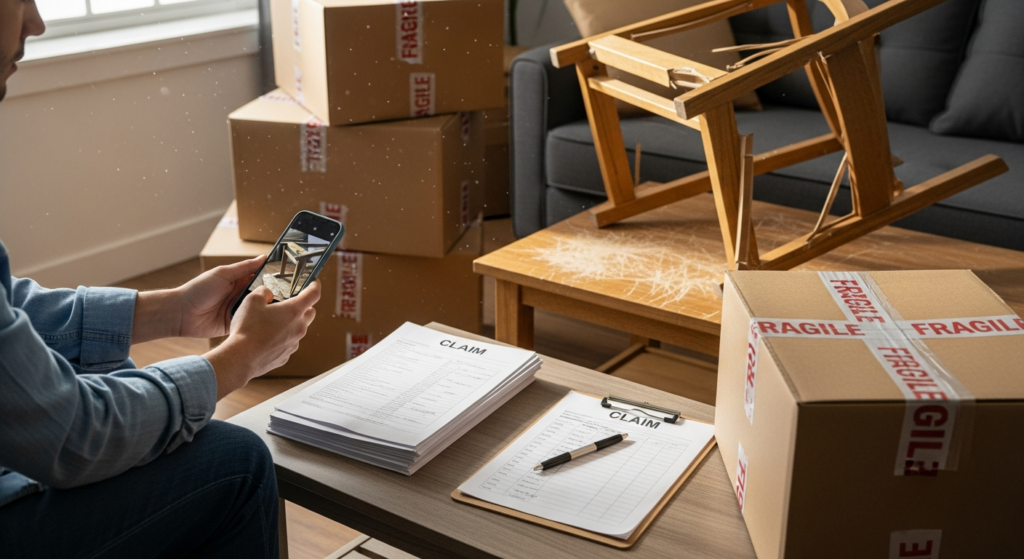
When a move goes wrong, your belongings are more than just scratched wood and broken glass. They are memories, daily essentials, and often expensive items. If you want the moving company to take responsibility, you need more than anger and frustration. You need a clear, organized, and well-documented moving damage claim file.
Carriers and their claims departments rely on paperwork, photos, valuation provisions, and federal or state rules to decide how much to pay, if anything. If your file is incomplete, confusing, or unsupported, it becomes easy for them to delay, deny, or dramatically reduce your payment. A strong file, built from the start, is your best leverage.
This guide walks you step by step through building a solid moving damage claim file: what documents matter, how to capture evidence, how to calculate the dollar amount, how to respond to low settlement offers, and when to escalate to regulators, arbitration, or court. It is written for consumers dealing with damage, missing items, or delivery disputes on household-goods moves in the United States.
This is general information, not legal advice. Rules can vary based on your specific contract, whether the move is interstate or intrastate, and state law. Always review your bill of lading, tariff, and claim instructions, and consider consulting an attorney or your state consumer-protection office for advice on your situation.
Key takeaways
- A strong moving damage claim file is organized, evidence-heavy, and tied directly to your bill of lading, inventory, and valuation selection.
- Take photos and video immediately at delivery, before signing that everything was received in good condition, and list visible damage on the paperwork.
- Track every item with its inventory number, condition, damage description, and supporting proof such as receipts, repair estimates, or replacement links.
- Know whether you chose released-value (60 cents per pound) or full-value protection, because this controls the maximum recovery for most claims.
- Respond to low settlement offers with calm, written rebuttals that attach evidence, highlight contract terms, and correct misstatements or math errors.
- Keep a timeline of communications and deadlines; late, incomplete, or verbal-only complaints are easy for movers to ignore or dismiss.
- If negotiations stall, consider formal complaints, the carrier’s arbitration program, state agencies, or legal review, depending on the type of dispute.
What is a moving damage claim file?
A moving damage claim file is the complete package of documents, photos, videos, estimates, correspondence, and forms you use to ask the moving company or carrier to compensate you for damaged or missing household goods. It is more than a claim form. It is your evidence folder and your negotiation toolkit.
Claims adjusters are trained to look for gaps: no proof of prior condition, unclear damage descriptions, missing receipts, or vague dollar amounts. When your file is complete and organized, you reduce their excuses to delay, underpay, or deny.
Think of your claim file as a story with supporting exhibits:
- Who moved you and under what contract and valuation terms
- What items were tendered to the mover and in what condition
- What happened during transit or delivery
- What was damaged or lost and how severely
- What it will reasonably cost to repair or replace those items
- How you have complied with deadlines and procedures
Step 1: Know what type of move you had
The rules that apply to your claim file depend heavily on what kind of move you had. Before you start organizing evidence, identify the basics.
Key move categories that affect your rights
| Move type | Typical rules | Why it matters for your file |
|---|---|---|
| Interstate (state to state) | Usually governed by federal law, FMCSA regulations, and the mover’s tariff. | Claim time limits, valuation options, and arbitration requirements are often spelled out in federal rules and the bill of lading. |
| Intrastate (within one state) | Typically governed by state law and state agencies such as a public utilities commission or consumer services division. | Deadlines and valuation options can differ from interstate moves; state complaint processes may be available. |
| Local or hourly moves | Often under local or state contracts with less detailed paperwork, but still subject to consumer laws. | You may need to rely more heavily on general consumer protection laws and contract terms. |
| Corporate, military, or relocation package | May follow special contracts arranged by an employer or government agency. | You may have additional channels for complaints, but also extra rules to follow. |
To identify your move type, check:
- The origin and destination addresses
- The company name and USDOT or state license number on the bill of lading
- Whether your paperwork references federal regulations, tariffs, or a relocation program
Once you know your move type, it becomes easier to understand which deadlines and procedures you must follow when building your claim file.
Step 2: Gather your core documents
Your core documents are the foundation of the claim file. Adjusters will refer to them constantly. Keep them together in a physical folder and a digital folder (scanned or photographed).
Essential documents to include
- Bill of lading (BOL) – The main contract for carriage, usually signed at pickup and sometimes at delivery.
- Order for service / estimate / confirmation email – Shows what services were promised and the pricing structure.
- Inventory sheets – Numbered list of items, often with condition codes, prepared by the mover at pickup.
- Delivery receipt / household goods receipt – Signed at delivery; often where you note visible loss or damage.
- Valuation election form – Where you chose full-value protection or released-value (such as 60 cents per pound per article).
- Tariff or terms and conditions – Sometimes provided electronically; describes liability limits and claim procedures.
- Emails and text messages with the mover – Especially those discussing damage, delays, or missing items.
- Invoices and proof of payment – To show the services were completed and paid for.
Core documents quick-reference table
| Document | Why adjusters care | Where to find it |
|---|---|---|
| Bill of lading | Shows contract terms, valuation choice, signatures, and sometimes exceptions written at delivery. | Your moving folder, confirmation emails, or the carrier’s customer portal. |
| Inventory sheets | Used to confirm items were tendered and note pre-existing damage codes. | Usually provided at pickup; sometimes reprinted at delivery. |
| Valuation form | Determines whether you recover full-value or limited cents-per-pound amounts. | Attached to your BOL or emailed as a separate document. |
| Delivery receipt | Shows whether you noted loss/damage at delivery or signed as received in good condition. | Paper or electronic signature pad at destination. |
If you are missing any of these, request them in writing from the mover as early as possible. Keep a copy of your request in the claim file.
Step 3: Document damage and missing items
Your photos, videos, and written descriptions turn a general complaint into a documented loss. The more specific and time-stamped your evidence, the stronger your file.
Photograph and video everything methodically
- Take wide shots of each room showing boxes and furniture as they are unloaded and unpacked.
- Take close-ups of each damaged area from multiple angles with good lighting.
- Include an item’s entire surface (e.g., the whole dresser) and then zoom in on cracks, dents, and gouges.
- Photograph box labels, inventory tags, and any crushed or torn packaging.
- If possible, turn on the date/time stamp or keep photos in an album labeled with the delivery date.
Write clear damage descriptions
Pair each photo with a short, factual description. Avoid vague phrases like “broken” without detail. Instead, specify location, type of damage, and how it affects use.
Example wording for your notes or claim form:
- Inventory #34 – Solid wood dining table – 72″ x 36″ – large gouge and deep scratch approximately 8″ long on top surface near center; finish chipped down to bare wood.
- Box #112 – marked “Kitchen – glasses” – arrived crushed on one side; four stemmed wine glasses inside shattered; purchased as set of 8 last year.
Track missing items separately
- List the inventory number and description for each missing piece, as shown on the inventory sheet.
- Note where it was last seen (origin, loading, or previous residence).
- Check with the driver and crew immediately at delivery in case items are still on the truck.
- Follow up in writing within the time period specified by your contract or claim instructions.
Step 4: Organize your evidence like a claims pro
Even strong evidence can lose impact if it is scattered through emails and random photo folders. Adjusters are more likely to take your claim seriously when everything is easy to follow.
Create a master claim spreadsheet
A simple spreadsheet can become the backbone of your file. Include one row per item or per box, with columns such as:
- Inventory number / box number
- Item description
- Original condition (brief)
- Type of issue (damaged, missing, delayed)
- Detailed damage description
- Original purchase date and price (if known)
- Source of proof (receipt, bank statement, online link)
- Proposed repair or replacement cost
- Photo file name or reference
- Settlement status (offered, accepted, disputed)
Sample organization table
| Column | What to enter | Why it helps |
|---|---|---|
| Inventory / Box # | Number from mover’s inventory or box label (e.g., Inv #34, Box #112). | Connects your claim to the mover’s own records. |
| Damage description | Short but specific description, such as “front left leg broken” or “screen cracked diagonal”. | Shows impact on usability and repair feasibility. |
| Proof & photos | Receipt date, store, photo filenames, or URLs to replacement items. | Lets the adjuster confirm value quickly. |
Build folders that mirror your spreadsheet
- Create a main digital folder called “Moving Claim – <Your Last Name>”.
- Inside, add subfolders like: 01 Core Documents, 02 Photos, 03 Estimates, 04 Correspondence, 05 Claim Forms.
- Name photo files with the inventory or box number and a short description (for example, Inv34_dining_table_top_gouge.jpg).
- Save emails as PDFs and name them with date and subject.
Step 5: Understand your valuation and liability limits
Your valuation selection is often the single biggest factor in how much compensation you can realistically obtain. It also shapes what you should ask for in your claim file.
Common valuation options
| Valuation type | How liability is calculated | Practical impact on your claim |
|---|---|---|
| Released-value protection (e.g., 60¢/lb per article) | Carrier pays up to a set cents-per-pound rate based on the item’s weight, regardless of its replacement cost. | High-value but light items (TVs, electronics) may result in very low payouts. |
| Full-value protection (FVP) | Carrier may repair, replace, or pay the current market value up to a declared shipment value. | Payouts are closer to real replacement/repair costs, subject to policy limits and exclusions. |
| Third-party moving insurance | Separate policy with its own deductibles, exclusions, and claim procedures. | You may need to file both with the carrier (for valuation) and the insurer (for additional coverage). |
Review your valuation form and tariff to confirm:
- Which valuation option you selected (and whether you signed a waiver of higher coverage)
- Any shipment-wide limits or per-article caps
- Exclusions (for example, certain fragile items packed by owner)
- Deductibles or minimum claim amounts
Knowing this up front prevents you from building unrealistic expectations and helps you focus on what is recoverable.
Step 6: Calculate and support your claimed amount
Adjusters are not supposed to guess what you want. Your claim file should clearly state the amount you are seeking for each item and for the claim as a whole, backed by reasonable proof.
Evidence that supports value
- Original receipts or invoices
- Bank or credit card statements showing purchase amounts
- Online product pages for the same or comparable item (with price and description)
- Repair estimates from reputable shops (for furniture, appliances, electronics)
- Statements or letters from specialty repair professionals when items are unique or antique
Sample valuation and depreciation table
| Item | Original price & age | Claimed amount rationale |
|---|---|---|
| Sofa (Inv #21) | Purchased 3 years ago for $1,200 (receipt attached). | Furniture repair estimate: $450 to repair frame and reupholster torn arm. Claiming $450 repair cost. |
| Television (Inv #58) | Bought 2 years ago for $800 (bank statement). Weight approx. 40 lbs. | Under released-value at $0.60/lb, max carrier liability is $24. Claiming $24 due to contractual limit, noting actual replacement cost is higher. |
| Dining table (Inv #34) | Purchased 5 years ago for $900 (online order confirmation). | Current comparable model: $950 (link provided). Carrier may depreciate; claiming $800 based on age and condition pre-move. |
If the mover or claims company applies depreciation, ask them to explain their method in writing. You can then decide whether to challenge unreasonable depreciation in your rebuttal.
Sample wording for itemized claim descriptions
“For Inventory #34 (solid wood dining table), I am claiming $800. The table was purchased for $900 in 2019 (receipt attached) and was in very good condition with only minor wear as shown in pre-move photos. Repair estimates indicate that refinishing the top would cost more than the depreciated value, so replacement is more reasonable. A comparable table currently retails for $950 (link attached).”
Step 7: Track timelines and claim deadlines
A well-documented file can still fail if it is submitted late or if you miss important response dates. Carriers and insurers rely on written deadlines in the bill of lading, tariff, and federal or state regulations.
Typical timeframes to watch (check your paperwork)
- Deadline to report loss or damage after delivery (sometimes a few days to note visible damage)
- Deadline to submit a written claim with itemized details (commonly several months)
- Time given to respond to settlement offers or requests for more information
- Time limits to demand arbitration or file a lawsuit, if necessary
Example timeline table for your file
| Event | Date | Notes |
|---|---|---|
| Pickup date | 06/05/2026 | Bill of lading and inventory signed; valuation form completed. |
| Delivery date | 06/15/2026 | Noted visible damages on delivery receipt. |
| Initial written notice | 06/18/2026 | Emailed mover with list of issues and photos. |
| Formal claim filed | 07/20/2026 | Submitted itemized claim form and evidence via certified mail. |
Keeping a timeline helps you prove you acted promptly and shows regulators or arbitrators that you met the required deadlines.
Step 8: Submit a clear, complete claim package
When your evidence is ready, you will usually complete the mover’s claim form or portal submission and attach your supporting documents. The goal is to make your package so clear that an adjuster can understand it without back-and-forth.
Checklist: Before you submit
- Completed claim form with your contact information, move details, and shipment ID.
- Itemized list matching your spreadsheet, including inventory numbers and claimed amounts.
- Copies of the bill of lading, inventory sheets, valuation form, and delivery receipt.
- Photos and videos labeled or referenced in your spreadsheet.
- Receipts, statements, repair estimates, and replacement links for higher-value items.
- Any correspondence showing admissions or promises from the mover.
- Cover letter or email summarizing the claim and key points.
Sample wording for a claim cover letter
“Enclosed is my formal claim regarding damage and loss to my household goods transported under Bill of Lading #123456 by ABC Moving Company from Austin, TX to Denver, CO, delivered on June 15, 2026. I am submitting an itemized list of affected items with inventory numbers, photos, receipts, and repair/replacement documentation. The total amount claimed, based on my valuation coverage, is $3,475. I look forward to your written response within the time frame outlined in your tariff and the bill of lading.”
Follow the carrier’s instructions on where and how to submit (mail, email, portal) and keep proof of delivery such as certified mail receipts or email confirmations.
How movers and claims departments may respond
Once your claim file is submitted, the mover or its third-party claims administrator will review it. Understanding their typical responses helps you plan your next moves.
Common types of responses
- Request for more information – They may ask for additional receipts, photos, or clarification of damage descriptions.
- Partial offer – They might agree to pay for some items but deny others, or apply depreciation or valuation limits.
- Denial – They may deny the claim in whole or part, citing exclusions, alleged pre-existing damage, or inadequate proof.
- No response or delays – In some cases, you may encounter repeated delays or silence.
Typical mover arguments vs. your countermeasures
| Mover/adjuster position | What it means | How a strong file responds |
|---|---|---|
| “Pre-existing damage” | They claim the item was already damaged before the move. | Provide pre-move photos, inspection notes, or witness statements showing condition at origin. |
| “Packed by owner” exclusion | They may assert limited liability for boxes you packed. | Show proof that the mover packed the items, or highlight unusual damage patterns consistent with mishandling, not packing error. |
| “Weight-based valuation limit” | They apply cents-per-pound limits to reduce payout. | Verify the correct weight, valuation rate, and that they are applying the right figure to the right item. |
Always insist on written explanations, not just verbal statements over the phone. Ask them to cite the specific contract provision, tariff rule, or valuation term they rely on.
How to counter low settlement offers
Low initial offers are common. A strong claim file lets you respond with facts instead of frustration.
Checklist: Responding to a low offer
- Read the offer carefully and note how they calculated each item.
- Compare their weight, depreciation, or coverage assumptions with your documents.
- Mark which items you accept, which you dispute, and why.
- Prepare a written rebuttal summarizing the main disagreements.
- Attach or reference specific photos, receipts, or contract language that support your position.
- Keep the tone firm but professional; avoid threats or emotional language.
Sample wording for a rebuttal letter
“I appreciate your review of my claim. However, I dispute your proposed settlement for the following items:
1. Inventory #34 (dining table): You applied a 60% depreciation that is inconsistent with the table’s age and excellent pre-move condition as shown in attached photos. A comparable table currently sells for $950 (link attached). I believe a depreciation of no more than 30% is reasonable, and I continue to claim $800.
2. Inventory #58 (television): You applied the released-value rate of $0.60 per pound based on an assumed weight of 30 lbs. The manufacturer’s specifications show a weight of 40 lbs (screenshot attached). Under the contract rate, liability should be calculated as 40 lbs x $0.60 = $24.
Please reconsider your offer in light of the attached documentation and provide a revised written response.”
Common mistakes that weaken your file
Even careful consumers fall into traps that make it easier for movers to reduce or deny payments. Knowing these pitfalls in advance helps you avoid them.
Mistake and countermeasure table
| Common mistake | Why it hurts your claim | Stronger approach |
|---|---|---|
| Signing delivery receipt as “all good” without inspection | Mover may argue there was no visible damage at delivery. | Perform a basic walk-through, note any visible damage, and write “subject to further inspection” if allowed. |
| Relying on phone calls only | Verbal conversations leave no paper trail for regulators or arbitrators. | Confirm key conversations by email and keep copies in your claim folder. |
| Submitting a vague, lump-sum demand | Adjusters cannot verify individual items or values. | Provide an itemized list with inventory numbers, descriptions, and claimed amounts. |
Other pitfalls to avoid
- Waiting months to take photos, so condition at delivery is unclear.
- Throwing away damaged items before the mover can inspect them (unless safety requires disposal; in that case, document thoroughly first).
- Accepting verbal promises in place of written offers or agreements.
- Ignoring the valuation limits and assuming full replacement value when you chose released-value coverage.
Escalation options: complaints, arbitration, court
If negotiations stall or you believe the mover is acting in bad faith, you may need to consider escalation. The right path depends on your move type, contract terms, and the size and nature of your claim.
Potential escalation channels
- Internal appeal – Ask the company to have a manager or different adjuster review your file.
- FMCSA complaints (interstate moves) – The Federal Motor Carrier Safety Administration maintains a National Consumer Complaint Database where you can report issues related to household-goods carriers.
- State consumer protection or utilities agencies – Many states regulate movers and handle complaints for intrastate moves.
- Arbitration – Many interstate movers must offer arbitration for certain disputes, especially loss and damage claims.
- Small claims or civil court – For some disputes, you may choose to seek judicial review, subject to contract terms and legal advice.
Before escalating, make sure your file is as strong as possible: organized evidence, clear timeline, and documented attempts to resolve the issue directly. Regulators and arbitrators are more likely to engage when they can easily see the facts.
What not to sign or say too early
Your words and signatures can affect your rights. Be cautious about what you agree to, especially under pressure at delivery or during early phone calls with the mover.
Be careful with the delivery paperwork
- Do not sign that everything is received “in good condition” if you see obvious damage or missing items.
- Ask if you can note visible problems on the delivery receipt before signing.
- If the driver refuses to let you write notes, calmly record the conversation (where legally allowed) and follow up in writing to the company immediately.
Release forms and quick checks
- Some movers may offer a small on-the-spot payment or discount if you sign a release of further claims. Read carefully before signing anything.
- If you do not fully understand a release, ask for time to review and consider independent advice.
- Do not agree over the phone that a small payment “fully resolves” the claim unless you are sure that is acceptable to you.
Quick checklists and sample wording
Use these condensed tools to strengthen your moving damage claim file in practice.
Quick-start evidence checklist
- Within 24–72 hours of delivery, walk through every room and inspect furniture and boxes.
- Photograph and video all visible damage and unusual packaging issues.
- List missing items and double-check against the inventory sheets.
- Collect receipts, bank statements, and online product links for higher-value items.
- Start your master spreadsheet with inventory numbers, descriptions, and notes.
- Request any missing paperwork (bill of lading, valuation forms) from the mover in writing.
Short sample email to notify the mover
Subject: Notice of loss and damage – Bill of Lading #123456
Dear [Mover Name],
I am writing to provide notice of loss and damage to my household goods transported under Bill of Lading #123456 from [Origin City, State] to [Destination City, State], delivered on [Delivery Date]. Several items arrived damaged or missing. I am currently documenting all affected items with photos and receipts and will submit a full written claim within your required time frame.
Please confirm the correct address or email for submitting my formal claim and provide a copy of your claim form and procedures.
Sincerely,
[Your Name]
[Your Contact Information]
Pre-submission mini-checklist
- Itemized spreadsheet completed with claimed amounts for each item.
- All supporting documents scanned or photographed clearly.
- File names and references consistent between spreadsheet and attachments.
- Cover letter summarizes the claim and total amount.
- Submission method follows the mover’s instructions and provides proof of delivery.
Frequently asked questions
How long do I have to file a moving damage claim?
Time limits depend on your bill of lading, the mover’s tariff, and whether the move was interstate or intrastate. Many carriers require written claims within several months of delivery, but some deadlines are shorter. Always check your contract documents and follow the earliest applicable deadline.
Do I need receipts for every damaged item?
Receipts are very helpful, especially for high-value items, but they are not always required. You can also use bank or credit card statements, online product pages, and reasonable written estimates of value. The stronger your proof, the harder it is for the carrier to dispute your amounts.
What if I signed the delivery receipt saying everything was OK?
Signing “received in good condition” can make your claim harder, but it does not always end your rights. You can still report concealed damage discovered after unpacking, as long as you comply with the mover’s reporting deadlines. Detailed photos, inventory references, and prompt written notice become especially important in this situation.
Should I throw away damaged items after I take photos?
If possible, keep damaged items until the mover or claims company confirms whether they want to inspect or salvage them. If safety or space requires disposal, document the items thoroughly with photos and video first, and let the mover know in writing why you had to dispose of them.
Can the mover make me use their repair company?
Under many full-value protection plans, the mover has the option to repair, replace, or pay you. They may suggest certain repair vendors. You can ask for details about the proposed repair and, if you have concerns, seek your own estimate. Ultimately, what is reasonable depends on your contract and the specific circumstances.
What if the mover ignores my claim or takes too long?
If you are met with long delays or no response, send a polite written follow-up referencing your original submission and asking for a status update. Keep records of all attempts to communicate. For interstate moves, you may also consider filing a complaint with the FMCSA. Check your paperwork for any timelines the mover must follow.
Is depreciation always allowed on damaged items?
Many carriers apply depreciation based on age and condition of the item, especially when paying actual cash value. The specifics depend on your valuation type and tariff. You can ask the carrier to explain their depreciation method and challenge it if it seems unreasonable or inconsistent with your documents.
Do I need a lawyer to pursue a moving damage claim?
Many consumers handle smaller claims on their own using a strong, organized file. For large losses, complex disputes, or potential legal claims beyond basic loss and damage, you may want to consult a lawyer experienced in transportation or consumer law to review your options.
Can I go straight to court instead of filing a claim?
Your bill of lading or tariff may require that you first file a written claim with the carrier and wait for a decision before pursuing arbitration or court. Failing to follow these steps can affect your ability to recover. Review your contract terms and consider legal advice before bypassing the claim process.
Official sources & further reading
For more detailed information about your rights and responsibilities in U.S. household-goods moves, see these official and authoritative resources:
- FMCSA Protect Your Move – Federal Motor Carrier Safety Administration guidance on choosing movers and understanding interstate moving regulations.
- FMCSA National Consumer Complaint Database – Online portal for filing complaints against interstate household-goods carriers.
- 49 CFR Part 370 – Principles and practices for the investigation and voluntary disposition of loss and damage claims – Federal regulations for handling certain transportation claims.
- 49 CFR Part 375 – Transportation of household goods in interstate commerce – Rules for interstate household-goods movers, including information for consumers.
- Your state’s consumer protection office or public utilities commission – Many states regulate intrastate movers and publish complaint procedures on their official websites.
- Your bill of lading, mover’s tariff, and written estimate – These documents contain the specific claim procedures, valuation terms, and deadlines that apply to your shipment.
This guide is general information, not legal advice. For a specific dispute, consult a qualified attorney or your state consumer-protection office.