
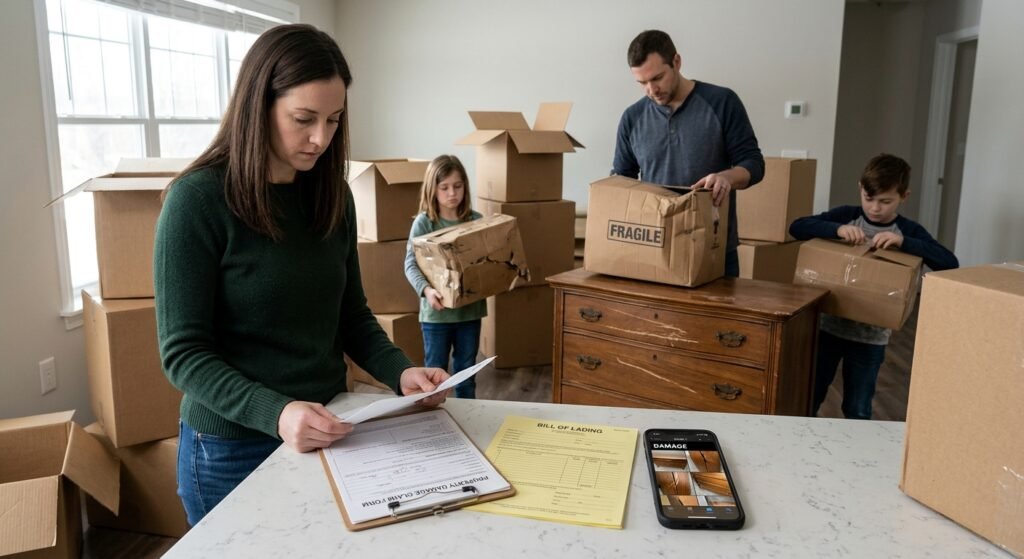
When a move goes wrong, the chaos is not just emotional. It is paperwork, deadlines, photos, estimates, and confusing emails with the mover or third-party claims company. A strong moving damage claim file is what turns that chaos into a clear story the carrier cannot easily ignore.
Most people lose money after a bad move not because the damage was small, but because their documentation was scattered, incomplete, or sent too late. Carriers, adjusters, and arbitration programs live on documents. Whoever is most organized usually has the advantage.
This guide walks you through how to document and organize your moving damage claim file step-by-step: from the first photos at delivery to labeling folders, tracking deadlines, calculating amounts, and responding to weak settlement offers. You will see practical examples, checklists, sample wording, and tables you can adapt to your own situation.
Rules and timelines can vary depending on whether your move was interstate, intrastate, local, military, or international, and on the valuation option you selected. Always review your bill of lading, tariff, estimate, and any claim form instructions. This guide is general information to help you build a clearer, better-organized file, not legal advice for a specific dispute.
Key takeaways
- Create a single, organized claim folder (digital or physical) with subfolders for documents, photos, estimates, and communication logs.
- Document issues starting at delivery: note damage on the delivery receipt if possible, take clear photos, and keep boxes and packing materials until the claim is resolved.
- Include all core documents: bill of lading, estimate, inventory, valuation election, delivery paperwork, contracts, and all written communication with the mover.
- Use clear valuations and depreciation calculations supported by receipts, price links, or repair estimates, not just guesses or emotional statements.
- Keep a dated log of every phone call and email with the mover or claims company; follow up in writing after important conversations.
- Do not sign broad releases, “settled” receipts, or quick cash offers before you understand the impact on your entire claim.
- If the carrier ignores you or makes an unreasonably low offer, a clean, well-organized file helps when escalating to arbitration, FMCSA complaints, or small claims court.
Why organization matters in a moving damage claim
Moving carriers and their claims departments work from documents. They are looking for clear answers to questions like:
- What was shipped?
- In what condition did it leave and arrive?
- What valuation coverage did you choose?
- What is the provable dollar amount of your loss under that coverage?
- Did you meet notice and filing deadlines?
If your material is scattered through random emails, unsorted phone photos, and crumpled receipts, it is easier for the carrier to say your claim is incomplete or poorly supported. A well-organized file, on the other hand, tells a clear story. It gives the adjuster less excuse to delay, misplace, or underestimate what you are owed under the applicable rules and your contract.
Good organization helps you:
- Meet filing and response deadlines shown on your bill of lading and tariff.
- Quickly answer questions from the adjuster or arbitration program.
- Spot inconsistencies between the mover’s story and their own documents.
- Stay calm and factual instead of relying only on frustration or emotion.
Start at delivery: documenting problems the right way
How you document issues at delivery can strongly influence how your claim is viewed later. You might not catch every problem on day one, but the more you capture up front, the stronger your position.
Step 1: Watch the unloading and make notes
- Be present during unloading if possible.
- As boxes and furniture come in, quickly inspect for obvious damage: crushed boxes, torn wrapping, broken legs, wet cartons.
- Set aside questionable items in a small “inspection area” for closer review once the crew leaves.
Step 2: Note damage on delivery paperwork
Most interstate moves and many intrastate moves use some form of delivery receipt or inventory check-off sheet. Where possible:
- Clearly write visible problems before signing, such as: “Box #27 crushed; dining table leg broken; sofa fabric torn on right arm.”
- Avoid generic language like “subject to inspection” alone; be specific where you already see issues.
- Ask for a copy or take a photo of the signed paperwork.
Sample wording for notes on delivery paperwork:
“Customer notes: several damaged items observed at delivery including: Box 12 crushed, contents unknown; dresser large gouge on top; glass tabletop shattered in box 44. Full list to follow after unpacking.”
Step 3: Take immediate photos and videos
- Photograph damaged items in place as they are unloaded if possible.
- Take wide shots (room context) and close-ups (damage details).
- Include photos of boxes, labels, and inventory stickers.
- Document packaging: crushed corners, wet cardboard, missing padding, or loose items.
Step 4: Keep packaging until the claim is resolved
Do not rush to throw away boxes, packing paper, or broken pieces.
- Claims adjusters sometimes want to see how items were packed.
- Packaging can show mishandling, overloading, or inadequate padding.
- If the mover requests inspection, you will still have the materials.
Core documents every claim file should contain
Your claim file is built around certain key documents. Collect these as early as possible and keep them together.
| Document | Why it matters | Where to find it |
|---|---|---|
| Bill of lading (BOL) | Main contract for the move; includes basic terms, carrier identity, and often claim time limits. | Given at pickup and/or delivery; ask the mover if missing. |
| Order for service / estimate / confirmation email | Shows scope of service, estimated charges, and some valuation information. | Originally emailed or handed to you when you booked. |
| Household goods inventory | Lists items, tag numbers, and sometimes condition codes, crucial for missing or substituted items. | Provided by driver/crew at pickup; you sign it. |
| Valuation election form (e.g., full value vs. released rate) | Determines the carrier’s liability limits and how compensation is calculated. | Often attached to estimate or BOL; may be separate. |
| Pickup and delivery receipts / weight tickets (if any) | Supports charges and timing; can help in delay or overcharge disputes. | Given at each service point or via email. |
Also gather:
- All emails with the mover, broker, or claims company.
- Text messages about delays, damage, re-delivery, or extra charges.
- Any photos or videos taken at origin before loading.
- Copy of the carrier’s tariff or a link to where it is posted.
- Claim forms or online-portal confirmation pages.
How to set up a simple but powerful claim file system
You do not need complicated software. What matters is that you can quickly find any document or photo when you need it.
Option A: Digital-first system
Create a main folder on your computer or cloud drive labeled something like “Moving Claim – [Mover Name] – [Month Year]”. Inside that folder, create subfolders such as:
- 01 – Contracts & BOL
- 02 – Inventories & Valuation
- 03 – Photos & Videos
- 04 – Estimates & Receipts
- 05 – Communication Log & Emails
- 06 – Submitted Claim Forms
- 07 – Offers, Responses & Escalations
Scan or photograph any paper documents and save them into the appropriate subfolder. Rename files with clear titles and dates, such as:
- 2026-05-10-bill-of-lading-signed.pdf
- 2026-05-12-photo-dining-table-leg-crack-1.jpg
- 2026-06-01-email-carrier-claim-acknowledgment.pdf
Option B: Paper-first system
If you prefer paper, create a sturdy binder or accordion file with labeled tabs matching the categories above. Print key emails and keep a handwritten or printed communication log in the front. Still, consider having digital backups (photos of documents) in case anything is lost.
Checklist: basic file setup
- Set up one main claim folder (digital or paper).
- Create labeled subfolders or tabs for each document category.
- Scan or photograph any paper-only items.
- Rename digital files with clear titles and dates.
- Back up your folder to cloud or external storage.
Photo and video evidence: what adjusters actually need
Photos and videos are often the most persuasive part of your claim file. The goal is to show clearly:
- The condition of items before and after the move (if possible).
- The type and extent of damage.
- The way items were packed or handled.
- Any packaging or environment issues (water, dirt, crushed boxes).
How to take effective damage photos
- Use good light. Natural daylight helps. Avoid dark, grainy images.
- Take multiple angles. At least one wide shot, one mid-distance, and several close-ups.
- Include context. Show the whole item, not just the crack or stain.
- Show labels and tags. Capture inventory stickers or box labels alongside damage.
- Do not over-edit. Avoid filters or anything that could be accused of altering the image.
Naming and organizing photos
Save photos into your Photos & Videos folder and rename them in a consistent way. For example:
- 2026-05-12-photo-box27-crushed-1.jpg
- 2026-05-12-photo-sofa-right-arm-tear-2.jpg
- 2026-05-12-photo-dresser-top-gouge-1.jpg
If you submit photos through an online portal, keep a copy. If you texted them to a driver or salesperson, move them into your organized claim folder as well.
Video tips
- Walk slowly around damaged items and narrate briefly: “This is the right side of the dresser; this gouge runs about 10 inches.”
- Do not talk emotionally about blame; just describe what you see.
- Save videos with descriptive names and dates.
Example: evidence table for major items
| Item | Evidence files | Notes |
|---|---|---|
| Dining table (inventory #54) | photo-table-leg-crack-1.jpg; photo-table-overall-1.jpg; video-table-wobble.mp4 | Leg split near joint; table now unstable; no prior damage. |
| Sofa, right arm | photo-sofa-arm-tear-1.jpg; photo-sofa-arm-closeup-2.jpg | Tear approx. 3 inches; appears snagged on metal during handling. |
| Box 27 (kitchenware) | photo-box27-crushed-1.jpg; photo-broken-dishes-1.jpg | Outer carton visibly crushed; several plates shattered. |
Inventories, checklists, and tracking missing items
The household goods inventory (if one was prepared) is a central document for missing or swapped items and can also be important for damage. Many long-distance carriers use numbered stickers and condition codes (like “S” for scratched, “M” for marred).
How to use the inventory for your claim
- Make a copy of the signed inventory for your claim file.
- Highlight items that are missing, damaged, or delivered as different items than what was picked up.
- Compare origin condition codes with the actual condition at delivery.
Create your own loss checklist
If the mover did not create an inventory, or if it is incomplete, build your own claim checklist. Include:
- Item name and brief description.
- Brand/model if known.
- Original purchase year (approximate if needed).
- Original purchase price and proof if available.
- Type of problem: missing, broken, stained, dented, etc.
- Requested remedy: repair, replacement, or compensation under valuation limit.
| Item / description | Problem | Notes for claim |
|---|---|---|
| Queen bed frame (cherry wood) | Side rail split; hardware missing | Inventory #31; purchased 2019, approx. $700; cannot be assembled safely. |
| Box of office files | Missing | Labeled “Office – A”; not delivered; important personal and tax records. |
| Floor lamp | Bent pole, shade crushed | Not functional; replacement cost approx. $120. |
Checklist: inventory and loss list
- Obtain copy of the original household goods inventory (if any).
- Mark missing or damaged items directly on a copy.
- Create your own loss list with details and item values.
- Cross-reference your list with photos and receipts.
- Keep a running total of claimed amounts in a separate document.
Valuation, depreciation, and calculating dollar amounts
How much you can reasonably claim depends heavily on your valuation election and whether state or federal rules apply. For many interstate moves within the United States, the carrier’s liability is governed by the Carmack Amendment and related regulations, along with the valuation option you chose (such as full value protection or a lower “released” rate).
Always review your bill of lading, valuation form, and the mover’s tariff for the specifics that apply to your shipment.
Step 1: Confirm your valuation coverage
- Find your signed valuation election or the section on your BOL that describes it.
- Check whether you chose full value protection or a lower per-pound released rate (for example, $0.60 per pound per article).
- Note any deductibles or maximum caps per shipment.
Step 2: Calculate claimed values
For each damaged or missing item, you generally need:
- Original cost or approximate fair market value before the move.
- Age and condition before the move.
- Replacement cost today or repair estimate.
- Any depreciation applied, depending on your coverage and mover’s rules.
Example valuation table (for your personal worksheet):
| Item | Original price / year | Claimed amount / basis |
|---|---|---|
| Dining table | $900 in 2020 (receipt attached) | Claiming cost of repair $250 (repair estimate), or replacement if not repairable. |
| Sofa | $1,200 in 2018 (bank statement + online ad) | Claiming $400 for professional upholstery repair (estimate attached). |
| Box of dishes | Estimated $250 total in 2019 (no receipts) | Claiming $220 (replacement cost from retailer links). |
Depreciation considerations
Some movers or claim administrators apply depreciation to certain items (for example, electronics, mattresses, furniture) when calculating settlement amounts, depending on the valuation option and their tariff. They may look at:
- Age of the item.
- Expected useful life.
- Condition before the move.
You can prepare by including brief notes in your file about condition and providing photos from before the move if available.
Sample wording to describe pre-move condition:
“The queen bed frame was purchased new in 2019 and used in a non-smoking home. Before pickup it had only minor surface wear and no structural cracks or instability. There were no repairs or prior claims involving this item.”
Released rate coverage (e.g., $0.60 per pound)
If you chose or were defaulted into a basic released rate plan, the mover’s liability might be limited to a small amount per pound per article. In that case, you should still document full replacement or repair costs, but understand that your recovery may be limited by that per-pound amount.
Use your file to calculate both the real loss and the coverage-limited amount so you can see where the numbers come from.
Email, calls, and a communication log
Verbal conversations can easily be misunderstood, forgotten, or later disputed. That is why a written communication log is a key part of a strong claim file.
What to track in your communication log
- Date and time of each contact.
- Who you spoke with (name, title, phone, and company).
- Main points discussed, offers made, and any promises or deadlines mentioned.
- Follow-up actions you or they agreed to take.
You can keep this in a simple spreadsheet or a running document saved in your Communication Log folder.
| Date | Contact | Summary / next steps |
|---|---|---|
| 06/01/2026 | Spoke with Sarah, claims rep, ABC Moving Co. | She confirmed claim received and said review may take up to 30 business days. She requested additional photos of dining table leg. I agreed to email them today. |
| 06/15/2026 | Emailed Sarah and claims email address | Followed up about status; attached repair estimate. Asked for written confirmation of expected decision date. |
Follow verbal calls with written confirmation
Whenever you have an important phone conversation, send a short email summarizing what you understood:
“Thank you for speaking with me today about claim #12345. As I understand it, you will review the repair estimates and photos I sent and expect to provide a written response within 2 weeks. If anything in this summary is inaccurate, please let me know in writing.”
Save that email and any response in your claim folder.
Writing and submitting your claim package
Once your file is organized, you will submit a formal claim according to the carrier’s instructions. For interstate moves, carriers often require written claims within a specific period. The federal regulations in 49 CFR Part 370 describe general principles for processing claims, but individual carriers’ tariffs and your contract will control the exact method and deadlines.
Before you submit
- Check your bill of lading and any claim form instructions for time limits and required content.
- Confirm where and how the claim must be submitted (online portal, email, mail, or fax).
- Confirm any requirement to list specific dollar amounts.
- Make sure you have saved copies of everything you plan to send.
What a clear claim letter includes
Whether you use the mover’s form or your own cover letter, aim to include:
- Your full name, contact information, and move reference numbers.
- Pickup and delivery dates and locations.
- Carrier and, if applicable, broker names.
- A short, factual description of what went wrong (damage, loss, delay, overcharges).
- A detailed list of claimed items, with reference to attached evidence.
- The total amount you are claiming, or a note that some amounts are pending estimates if allowed.
Sample claim letter wording (excerpt):
“I am submitting this written claim regarding my household goods shipment handled by ABC Moving Co., picked up in Phoenix, AZ on May 5, 2026 and delivered in Denver, CO on May 12, 2026 under bill of lading number 987654.
During and after delivery, I discovered multiple damaged and missing items. Attached is a detailed loss list, supporting photos, receipts, repair estimates, and a copy of the bill of lading and valuation election. The total amount of loss I am claiming, subject to the applicable valuation limits, is $3,250.00.
Please confirm receipt of this claim in writing and advise if you require any additional documentation pursuant to your tariff and applicable regulations.”
Checklist: claim submission
- Completed carrier claim form or cover letter.
- Copy of bill of lading and valuation election.
- Loss list with claimed amounts and item details.
- Photos and videos (or link if the carrier specifies a method).
- Repair estimates or replacement cost documentation.
- Proof of ownership or value where reasonably available (receipts, bank statements, screenshots of online product pages).
- Copy of your communication log (if you want it in the record).
- Proof of submission (email sent, portal confirmation, mailing receipt).
Responding to low settlement offers or denials
Many consumers receive an initial settlement offer that feels unfairly low or a denial that seems to ignore key facts. A well-organized claim file helps you respond calmly and specifically.
Step 1: Compare the offer to your documentation
- Identify each item where their valuation differs from yours.
- Check whether they applied the correct valuation coverage (full vs. released rate).
- Look for missing or misread evidence (e.g., they treated an item as older or cheaper than shown in your receipts).
Step 2: Prepare a focused written response
A short, targeted letter or email is usually more effective than a long emotional complaint. Reference specific evidence.
Sample response wording:
“Thank you for your settlement letter dated July 15, 2026 regarding claim #12345. After reviewing your calculations, I believe some items have been undervalued based on the documentation in my file and the valuation coverage elected.
For example, for the dining table (Item 3 on my loss list), you valued the item at $150 using a depreciated amount. However, I provided a receipt showing a 2020 purchase for $900 and a repair estimate of $250. Under the full value protection option elected on my bill of lading, I understand that the carrier is responsible for repair, replacement with a similar item, or a cash settlement for the current market value, subject to the terms of your tariff.
Please review the attached documents again and let me know if you will adjust the offer on this item and the other items listed in the attached comparison chart.”
Using a comparison table
To keep things clear, you can create a simple comparison chart and send it as a PDF or spreadsheet.
| Item | Your claimed amount | Carrier offer / issue |
|---|---|---|
| Dining table | $250 repair cost (receipt & estimate attached) | Offered $75; carrier applied 70% depreciation despite 4-year-old item and full value protection election. |
| Sofa | $400 repair estimate | Offer $0, asserting pre-existing wear without evidence from origin inventory. |
Know when to accept, negotiate, or escalate
Only you can decide whether an offer is acceptable given your coverage, documentation, and the time and energy required to continue. Your organized file will help you weigh options like:
- Negotiating adjustments on certain items.
- Accepting a partial offer while reserving rights on disputed issues (if allowed).
- Moving forward to arbitration or small claims court, if available and appropriate.
Common documentation mistakes and how to avoid them
Many consumers make the same avoidable mistakes that weaken otherwise valid claims. Use this chart to double-check your own process.
| Common mistake | Why it hurts your claim | Better approach |
|---|---|---|
| Throwing away damaged boxes and packing | Destroys evidence of poor packing or rough handling; may limit what inspectors can see. | Keep packaging until the claim is concluded or the mover confirms it is no longer needed. |
| Relying only on phone calls | No written record of promises, deadlines, or explanations. | Follow calls with emails summarizing what was discussed; maintain a communication log. |
| Sending a claim without dollar amounts (when required) | Carrier may say no proper written claim was filed within the deadline. | List estimated amounts based on best available info and label them clearly as estimates if needed. |
| Submitting only emotional complaints | Does not give the adjuster concrete numbers or evidence to work with. | Combine a factual, organized file with a concise explanation of impact. |
Checklist: avoid these pitfalls
- Do not miss claim deadlines in your contract and tariff.
- Do not sign away rights without understanding the document.
- Do not rely on memory alone; write things down the same day.
- Do not send the only copy of a document without keeping a backup.
- Do not exaggerate or guess wildly at values; support them where you can.
When and how to escalate: FMCSA, arbitration, and court
If your organized claim file still does not produce a reasonable response, you may consider escalation options. What is available can depend on whether your move was interstate or intrastate, and what your contract says about dispute resolution.
FMCSA complaints (for interstate household goods moves)
For many interstate moves, the Federal Motor Carrier Safety Administration (FMCSA) offers a National Consumer Complaint Database where you can report issues with movers or brokers. While FMCSA does not resolve individual money disputes, complaints may prompt regulatory attention and sometimes encourage carriers to respond more seriously.
- Have your USDOT or MC number, mover name, and move dates ready.
- Summarize your claim and attach references to key documents.
- Keep a copy of your complaint confirmation in your claim file.
Arbitration programs
Some interstate carriers are required to offer neutral arbitration for certain disputes, especially over loss and damage or charges. Check your bill of lading and the mover’s tariff to see what arbitration options are available, time limits to file, and whether the outcome is binding.
- Gather your full claim file before filing for arbitration.
- Follow the arbitration provider’s instructions for submitting evidence.
- Use your organized tables and logs to present a clear case.
State consumer agencies and small claims court
For intrastate or local moves, your state public utilities commission, consumer protection office, or similar agency may regulate movers. They may offer complaint handling or mediation. Small claims court may be available for limited dollar amounts without needing a lawyer, depending on your state.
This guide cannot tell you which option is best in your specific situation. But no matter where you go, a thorough, organized claim file will help you present your side more effectively.
What not to sign or say too early
When you are exhausted from a bad move, it is tempting to sign whatever the mover puts in front of you just to be done. Be careful with documents that may waive rights or close your case prematurely.
Documents to review carefully
- “Settlement” or “release” forms that state you accept a payment “in full and final satisfaction” of all claims.
- Delivery receipts that include language about no damage or that all goods were received in good condition, especially if you have not fully unpacked.
- Quick cash offers at delivery that may undercut your later claim once full damages are known.
Reasonable documents you normally must sign at delivery (like acknowledging shipment received) can be acceptable, but you can sometimes add notes reserving your rights if permitted, such as:
“Received, subject to further inspection for concealed damage and loss.”
Ask for copies of anything you sign and store them in your claim folder.
Organizing digital vs. paper copies
Most modern claims are easier to manage digitally, but paper copies still matter for court, arbitration, or if you need to show a document in person.
Digital best practices
- Use consistent file names with dates and brief descriptions.
- Save emails as PDFs or print to PDF for long-term storage.
- Back up your folder to the cloud or an external drive.
- Consider a single PDF “packet” summarizing your claim to share with adjusters or arbitrators.
Paper best practices
- Use sheet protectors or folders for important originals (bill of lading, signed inventory, receipts).
- Label tabs clearly by topic (contracts, photos, estimates, correspondence).
- Keep the binder close by when you call the mover or attend any hearings.
- Store in a safe, dry place away from potential damage.
Sample claim timeline and follow-up schedule
Every move and carrier is different, but mapping out a general timeline helps keep your file and follow-up on track. Always check your specific contract and tariff language for exact deadlines.
| Time from delivery | Suggested actions | Notes for your file |
|---|---|---|
| Day 0–3 | Document visible damage on delivery paperwork, take photos and videos, set aside damaged items, keep packaging. | Begin a simple loss list; start your communication log if you contact the mover. |
| Day 4–14 | Finish unpacking, refine your loss list, gather receipts and research replacement costs, obtain repair estimates if needed. | Organize your claim folder; check your bill of lading for claim deadlines. |
| By carrier deadline (varies) | Submit written claim per the mover’s instructions, including itemized list and supporting evidence. | Save proof of submission and any acknowledgment. |
| 30–60 days after filing (varies) | Follow up if you have not received a written response within the timeframe stated in the carrier’s tariff or regulations. | Document follow-up communications; consider escalation if unreasonably delayed. |
Use this as a planning tool and adjust based on the specifics of your contract, whether the move is interstate or intrastate, and any claim form instructions.
Frequently asked questions
How quickly do I need to file a moving damage claim?
Deadlines depend on your contract, the mover’s tariff, and whether the move is interstate or intrastate. Many interstate carriers require written claims within a certain number of months from delivery. Check your bill of lading and any claim form instructions immediately so you do not miss a time limit.
What if I do not have receipts for everything?
You can still support value using reasonable alternative evidence: bank or credit card statements, order confirmations, screenshots of similar items from retailers showing current prices, or sworn statements about approximate cost and age. Be honest and consistent. Receipts help, but they are not always required for every item.
Do I need before-and-after photos to win my claim?
Before-and-after photos are helpful but not always necessary. Many people do not have pre-move photos of every item. Focus on clear after-move photos that show damage, plus any pre-move pictures you already posted on social media or have in your files. Inventory condition codes and witness statements can also matter.
Should I let the mover send a repair person to inspect items?
Carriers often have the right to inspect or attempt repair as part of the claim process. Cooperate reasonably, but keep your own photos, notes, and copies of any repair reports. If you disagree with a repair plan, explain your concerns in writing and keep it in your file.
Can I throw away broken items after I take photos?
Ideally, keep damaged items and packaging until your claim is resolved or the mover confirms in writing that you may dispose of them. If space or safety is an issue, photograph everything in detail from multiple angles and keep any easily stored parts (tags, labels, small broken pieces).
What if the claims company is not responding?
Update your communication log with each contact attempt, send follow-up emails referencing dates and prior messages, and review the mover’s tariff for response time expectations. For interstate moves, consider filing a complaint with the FMCSA if the carrier ignores reasonable inquiries. Your organized file will be valuable if you escalate to arbitration or small claims court.
Is it worth filing a claim for small items?
That depends on your time, coverage, and the number of smaller losses. If you have many low-value items that add up, it may be worth documenting them in a grouped way (e.g., “set of 10 glasses” rather than each glass separately) while staying honest and specific. Remember that basic released rate coverage may limit recovery on light items.
Do I need a lawyer to handle a moving damage claim?
Many people pursue routine loss and damage claims without an attorney, especially for smaller dollar amounts. A well-organized file, clear evidence, and knowledge of deadlines go a long way. For larger losses, complex legal issues, or if you are considering court, you may want to consult a qualified attorney in your state for legal advice.
Can I post reviews or complaints online while my claim is pending?
You generally have the right to share honest opinions, but be careful to stick to facts and avoid statements that could be characterized as false or defamatory. Posting a review does not replace a formal claim. Keep working on your organized file and official claim process, even if you also choose to warn others online.
Official sources & further reading
- FMCSA Protect Your Move – Official federal information for consumers planning interstate moves.
- FMCSA National Consumer Complaint Database – Portal for filing complaints against interstate movers and brokers.
- 49 CFR Part 370 – Principles and practices for the investigation and voluntary disposition of loss and damage claims.
- 49 CFR Part 375 – Transportation of household goods in interstate commerce.
- State public utilities commission or consumer protection office website for intrastate mover rules in your state.
- Your mover’s bill of lading, written estimate, tariff, and any arbitration program notice provided at booking or before loading.
This guide is general information, not legal advice. For a specific dispute, consult a qualified attorney or your state consumer-protection office.