
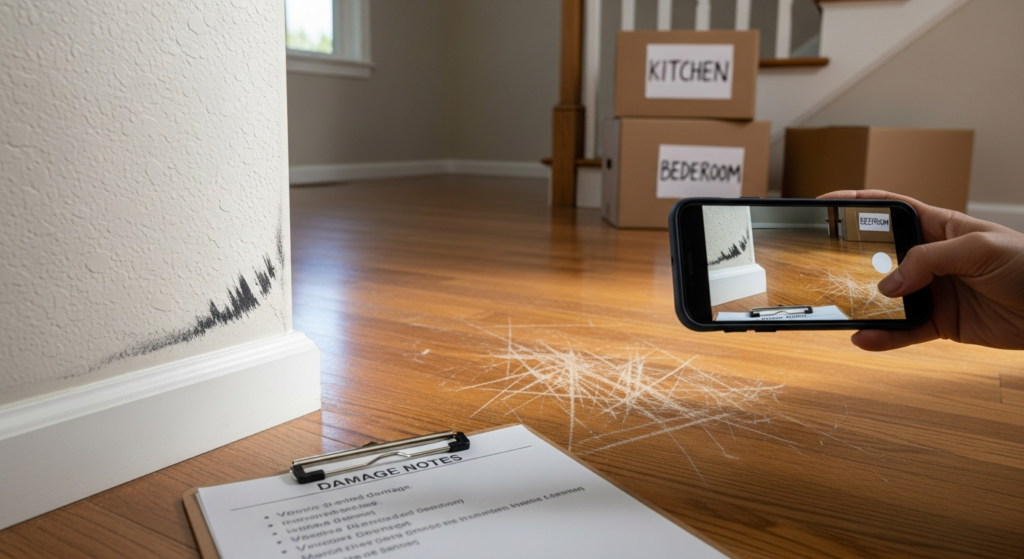
When movers damage your house itself — gouged walls, scratched hardwood floors, chipped banisters — things get serious quickly. You are not just dealing with a broken chair; you are dealing with damage to your biggest asset and potentially expensive repairs.
Most consumers are surprised to learn that claims for damage to the residence (walls, floors, doors, railings, driveways) are handled differently than damage to household goods. Liability can depend on your contract, the mover’s tariff, and whether the move was local, intrastate, or interstate. What you do in the first hours and days will heavily influence whether the mover accepts responsibility and how much they offer.
This guide walks you step by step through what to do right after you see home damage, how to document it, how to notify the mover, how these “property damage movers” claims are evaluated, and how to respond to low offers or denials. It is written to help you organize evidence, speak the mover’s language, and avoid common mistakes that weaken wall damage claims and floor scratch disputes.
This is general information about dealing with movers who damaged a house, not legal advice. Laws, deadlines, and procedures vary by state and by whether your move crosses state lines. Always check your bill of lading, written estimate, and any claim instructions from the mover or carrier.
Key takeaways
- Act immediately: photograph damage to walls, floors, doors, railings, and driveways before anything is repaired or cleaned.
- Note damage on any delivery paperwork if you see it before the movers leave, and keep a copy or take a photo of what you signed.
- Most movers require written notice for a wall damage claim or floor scratch incident, often within 30 to 60 days. Check your bill of lading and claim form for the specific deadline.
- Strong property damage movers claims rely on clear “before and after” evidence, detailed repair estimates, and a calm but firm written explanation of what happened.
- Home damage liability rules may differ from those that apply to damaged furniture; review the mover’s tariff and any separate property damage clauses.
- Do not accept or sign any “final” settlement or release until you understand the full repair cost and what rights you may be waiving.
- If the mover refuses to handle the claim fairly, you may have options through the mover’s arbitration program, state consumer agencies, FMCSA complaints for interstate moves, or small claims court.
First steps when you see house damage
When you notice fresh scrapes on your walls or deep floor scratches from movers, your instinct might be to confront the crew immediately. You should speak up, but the first priority is preserving evidence and preventing further damage.
Step 1: Make the area safe
- Stop any activity that might make the damage worse (for example, rolling heavy dollies across newly scratched floors).
- Point the damage out to the crew leader so they can adjust how items are being moved.
- For serious issues like broken stair treads, loose railings, or cracked tiles that could cause falls, block off the area until assessed.
Step 2: Capture the damage before anything changes
Do not wait until the movers leave to start documenting. The most persuasive home damage claims show fresh, untouched damage while the crew and equipment are still present.
- Take wide shots of each affected area (entire hallway, full wall, stairs, entryway).
- Take close-up shots at different angles, including a ruler or coin next to gouges or scratches for scale.
- Film a short video walk-through narrating what you see and pointing out any pads, dollies, or large items nearby.
Step 3: Say something before the crew leaves
Calmly let the crew leader or driver know there is damage to the property, not just your belongings.
“I need to document that there is fresh damage to my wall and hardwood floor that appears to have happened during today’s move. Please note this on your paperwork before we sign anything.”
Even if they say, “Claims will handle it,” you want something about the damage written on their delivery documents or inventory exceptions sheet.
How to document wall and floor damage
Good documentation is what turns “your word against theirs” into a well-supported file that a claims adjuster can work with. For any wall damage claim or floor scratch movers dispute, think in terms of three categories: condition, cause, and cost.
1. Document the condition
- Photos and video – Capture every angle with good lighting. Include close-ups with something for scale (tape measure, pen, coin).
- Room context – Stand back and show where in the house the damage is (entry hallway, stairs, bedroom corner).
- Multiple dates – If you have old listing photos, home inspection photos, or pre-move pictures showing undamaged walls and floors, save those too.
2. Document the likely cause
You do not have to prove the exact second the damage happened, but it helps to connect it logically to the move:
- Photo of a sharp furniture edge lined up with a fresh wall gouge.
- Photo of dolly wheel tracks leading to a long floor scratch.
- Photo of a tight stair turn where furniture was carried, now with damaged drywall.
Write a short factual description for your claim file:
“Wall behind the front door has two vertical gouges approximately 10 inches long, consistent with the metal edge of the refrigerator door which was carried through that entry.”
3. Document the cost to repair
Unlike furniture, walls and floors almost always require outside contractors. Start collecting information now, even if you do not submit estimates until later.
- Get written estimates from licensed painters, drywall repair companies, flooring refinishers, or tile setters.
- Ask the contractor to describe the damage on the estimate and specify whether spot repair is possible or if a larger area must be redone.
- Keep any invoices if emergency repairs were unavoidable (for example, a broken exterior door frame that will not close).
Documentation checklist for property damage movers claims
- Clear, dated photos and video of each damaged area
- Any “before” photos showing prior condition of walls or floors
- Written notes describing when you first noticed each issue
- Copy or photo of delivery paperwork with damage noted (if possible)
- Names of driver and crew members present
- Any witness statements (spouse, neighbor, realtor)
- At least one professional repair estimate per type of damage
How and when to notify the mover
Most companies have strict timelines and procedures for reporting property damage. If your movers damaged the house, decide quickly how you will notify them in writing.
Check the paperwork for claim instructions
Review:
- The bill of lading (contract of carriage)
- Any “Order for Service” or “Moving Services Agreement”
- The mover’s tariff or terms and conditions
- Any separate “Property Damage” or “Damage to Premises” clause
You’re looking for language such as:
- “Customer must report damage to premises in writing within X days of delivery.”
- “Claims for damage to walls, floors, or driveways must be submitted on company claim form.”
- “Carrier is not responsible for normal wear or minor scuffs; claims limited to direct physical damage.”
Send prompt written notice
Even if you are still gathering estimates, send a brief written notice as soon as you reasonably can. Email is usually best because it is timestamped.
Subject: Property damage during move on [date] – [Your name / Job #]
“This is to provide prompt written notice that during the delivery on [date], there was damage to my residence, including walls and floors. So far I have identified: (1) gouged drywall in the front entry, (2) scratched hardwood flooring in the living room, and (3) chipped stair railing. I am gathering photos and repair estimates and will submit a full claim. Please confirm your procedures and any forms or deadlines that apply to property damage.”
Attach a few representative photos with file names that make sense (for example, “entry_wall_gouge_1.jpg”).
Note any phone conversations
If you also speak with the mover or carrier by phone:
- Write down the date, time, name of the person, and what was said.
- Follow up with a short confirmation email, such as, “As we discussed on today’s call, I will submit repair estimates by [date].”
Property damage vs. household goods claims
Most consumers do not realize that property damage movers claims are often handled separately from personal property (furniture and boxes). The rules, limits, and paperwork can be different.
| Type of claim | Typical examples | How it is usually handled |
|---|---|---|
| Household goods | Broken table leg, crushed box, missing TV, dented fridge | Covered by federal or state rules on carrier liability; valuation level (released vs. full value) is critical. |
| Property / premises damage | Damaged walls, scratched hardwood floors, broken railings, damaged driveway or lawn | Often governed by contract terms, tariff, and general negligence principles; may be outside standard valuation caps. |
For interstate moves, federal regulations (such as 49 CFR Part 375) focus primarily on household goods, not on the residence itself. That does not mean movers can wreck your walls without consequences, but it does mean the legal framework is less standardized and more contract-driven.
For local or intrastate moves, state rules and the company’s own terms may dominate. Some states regulate property damage by movers more tightly than others, often through a public utilities commission or consumer protection agency.
Why this distinction matters
- The compensation formula for your sofa might be based on weight and valuation, while your wall repair is based on contractor estimates.
- Deadlines and forms may differ for household goods versus premises damage.
- Some movers try to route property damage through their liability insurance rather than their normal cargo claims process.
What your contract and tariff say about property damage
When movers damage your house, the starting point is your written agreement. Different companies take very different approaches to home damage in their contracts and tariffs.
Key clauses to look for
- Damage to premises / property – A section that specifically addresses walls, floors, elevators, lawns, and driveways.
- Exclusions – Phrases like “not responsible for normal wear” or “no liability for minor scuffs or nicks.”
- Limits – A flat dollar cap per incident or per move for property damage (for example, “liability for premises damage limited to $500”).
- Notice requirements – Deadlines and methods (email, claim portal, mailed form) for reporting property damage.
- Repair vs. replacement – Language indicating whether the company will send its own contractor to repair damage or simply pay you for repairs.
Example contract language and what it could mean
| Sample clause | Possible interpretation | Claim strategy |
|---|---|---|
| “Carrier is not responsible for normal wear to walls or floors.” | They might deny small scuffs or dirt marks as “normal wear,” but deep gouges or broken materials are different. | Emphasize that the damage is beyond normal wear and show clear, severe harm. |
| “Liability for damage to premises is limited to $X per occurrence.” | The mover may argue you cannot recover more than this cap even if repairs cost more. | Know the stated cap; collect full repair estimates anyway to understand the gap. |
| “Customer must permit carrier’s preferred contractor to perform repairs.” | They might want to use a lower-cost contractor instead of reimbursing your chosen professional. | Keep your own estimates for comparison and to argue for adequate repair quality. |
Contracts can be complex. If the language is confusing or seems unfair, you may wish to have a local attorney or consumer agency review it, especially for high-dollar damage.
Valuation, insurance, and what is actually covered
Many consumers assume that paying extra for “full value protection” will automatically cover any damage caused by movers, including damage to the home. That is rarely how it is written.
Valuation typically applies to goods, not the house
On interstate moves, the valuation level you select on the bill of lading usually governs only household goods — your furniture and boxes. It limits the mover’s liability for the items moved, not for drywall, rails, or flooring that belong to the building.
That can create a confusing gap: your wall damage claim may not be capped under valuation, but it might be subject to separate contractual limits or left to general negligence law.
Third-party liability insurance
Some larger movers have commercial general liability (CGL) policies that can respond to property damage claims. However:
- They may first try to resolve claims internally up to a certain dollar amount.
- They may require you to go through their claims department before involving their insurer.
- Insurance carriers usually demand thorough documentation and may investigate more aggressively.
What to ask the mover or carrier
- “Does my valuation selection on the bill of lading apply to damage to the premises, or only to my personal property?”
- “Is there a separate process or different adjuster for wall and floor damage?”
- “Are there any caps or exclusions on premises damage in your tariff or contract?”
Getting repair estimates for walls and floors
To get meaningful compensation for wall damage or a floor scratch movers incident, you need realistic repair pricing, not just a guess. Claims departments almost always want written estimates.
Choosing contractors
- Use licensed and insured contractors where possible, especially for structural, electrical, or high-value flooring work.
- For drywall and painting, you can use reputable local painters or specialized drywall repair services.
- For hardwood floors, look for refinishers who can evaluate whether spot repair is possible or if sanding and refinishing a whole area is required.
What a strong estimate should include
- Contractor’s name, address, and contact details
- Date of inspection and estimate
- Clear description of each damaged area and cause (for example, “gouge in drywall near entry, likely from furniture impact”)
- Breakdown of labor and materials
- Total estimated cost, with tax if applicable
Example repair estimate table
| Damage area | Proposed repair | Estimated cost |
|---|---|---|
| Entry hallway drywall gouge | Patch, sand, and repaint entire wall to blend color | $450 |
| Living room hardwood floor scratches | Sand and refinish affected boards, feathering into surrounding area | $1,200 |
| Stair railing chip | Fill, sand, stain, and seal to match existing finish | $250 |
Having more than one estimate can help, especially if the mover accuses a contractor of overpricing or insists on sending “their” contractor.
How to calculate and present your property damage claim
Once you have photos, descriptions, and estimates, bring them together into a single, organized claim package instead of a string of scattered emails.
Basic calculation approach
- Start with the full cost to repair each area using reasonable, local contractor pricing.
- List any amounts you already spent on temporary or emergency repairs.
- If the damage reduces the value of a feature even after repair (for example, partial floor patch that will still show), note that impact in your narrative.
Unlike furniture, depreciation is usually not applied to wall and floor repairs, because you are paying to restore the structure, not to replace an old item with a new one. However, some movers may argue that repairs “improve” the property and want to discount their share.
Sample claim summary table
| Damage item | Estimate(s) | Claimed amount |
|---|---|---|
| Entry hallway wall gouges | Contractor A: $450; Contractor B: $420 | $435 (average) |
| Living room floor scratches | Flooring pro: $1,200 | $1,200 |
| Stair railing chip | Carpenter: $250 | $250 |
Sample written claim narrative
“On [date], your crew performed my move from [origin] to [destination]. During delivery, damage occurred to my residence at [address]. The damage includes (1) gouged drywall in the entry hallway, (2) scratched hardwood flooring in the living room along the main path used by the crew, and (3) a chipped stair railing on the second-floor landing. These areas were undamaged prior to the move; I have attached pre-move photos and the home inspection report as reference.
I am requesting reimbursement of $1,885, representing the reasonable cost to restore these areas based on attached written estimates from licensed contractors. Photos, videos, and estimates are labeled and cross-referenced in the attached index. Please review and advise regarding your process and timeline for resolving this property damage claim.”
How movers and claims departments typically respond
Once your wall damage claim or floor scratch evidence is submitted, you can expect a range of possible responses from the mover or its claims administrator.
Common types of responses
- Request for more information – Additional photos, clearer descriptions, receipts, or more detailed estimates.
- Partial acceptance – Agreement on some damage but not others (for example, they accept the wall gouge but deny the floor scratches as “pre-existing”).
- Low offer – An offer that covers only a portion of the repair costs, sometimes citing internal repair rates or contract caps.
- Denial – A claim rejection, often based on alleged pre-existing damage, exclusions, or “normal wear” language.
Typical investigation steps
| Step | What the mover/adjuster may do | How you can prepare |
|---|---|---|
| Review paperwork | Check the bill of lading, notes on delivery receipts, and any inventory or condition reports. | Have your own copies ready and highlighted where damage was noted. |
| Interview crew | Ask the driver and crew if they recall damage or pre-existing conditions. | Stick to the documented facts; avoid speculation about what they said or thought. |
| Review photos | Analyze your photos to see if damage appears fresh and consistent with the described cause. | Provide clear, well-labeled images that support your timeline. |
Remain professional in all communications. Angry or threatening messages do not help your leverage; clear evidence and calm persistence do.
Dealing with low settlement offers or partial denials
If the mover responds with an offer that barely covers your repair costs — or refuses to accept responsibility for certain items — you do not have to accept immediately. You can respond in writing and support your position with facts.
Understand the mover’s reasoning
Ask for their explanation in writing if it is not already clear:
- “Please identify which contract provision or evidence you are relying on to deny the claim for the floor scratches.”
- “Can you explain how you calculated the proposed payment of $300 for the wall and floor repairs?”
Respond with targeted evidence
If they say the damage is “pre-existing,” show pre-move photos or inspection reports where the area appears clean. If they claim your estimate is too high, provide a second estimate or highlight exactly what the contractor will do.
“Your letter states that the hardwood scratches were ‘pre-existing.’ Attached are listing photos from three weeks before the move and a pre-move walkthrough video, both showing the living room floor without visible scratches. The long parallel marks now present line up with the path used to move the sofa and large dresser, as shown in my photos taken on delivery day.”
Negotiation and compromise
You may decide to accept a slightly lower amount to resolve the dispute quickly, especially for moderate damage. However, do not let the mover rely on vague statements like “this is all we usually pay” without reference to your contract or evidence.
- Ask if the offer is their “best and final” position.
- Clarify whether acceptance requires signing a broad release of future claims.
- Make sure all promised repairs or payments are in writing.
Organizing your evidence file
A chaotic collection of photos and emails makes it easy for adjusters to miss key facts. Treat your property damage movers claim like a small project file.
Suggested organization system
- Master folder – “[Mover Name] Property Damage Claim – [Your Last Name].”
- Subfolders – “Photos,” “Videos,” “Estimates,” “Emails,” “Contracts,” “Notes.”
- Index document – A one-page summary listing each damage item, file names, and page numbers.
Evidence tracking table
| Damage item | Evidence files | Notes |
|---|---|---|
| Entry wall gouge | Photos: EW1-EW4; Video: EW_vid1; Estimate: Painter_A.pdf | Noted on delivery receipt; crew leader acknowledged verbally. |
| Living room floor | Photos: FL1-FL6; Video: FL_vid1; Estimate: FloorPro1.pdf | Pre-move listing photo in file “House_before_3.jpg.” |
| Stair rail chip | Photos: SR1-SR3; Estimate: Carpenter1.pdf | Damage visible along path where king mattress was moved. |
When you send documents, consider combining PDFs so the adjuster can scroll through a logically ordered package instead of hunting through dozens of separate attachments.
Common mistakes to avoid
Many otherwise valid property damage claims are weakened by avoidable missteps.
Frequent errors
- Waiting weeks to report wall or floor damage to the mover.
- Repairing everything immediately and only then telling the mover (without photos or estimates).
- Submitting only a single blurry photo per area.
- Arguing emotionally instead of pointing to specific contract terms and evidence.
- Signing broad releases included with small settlement checks without understanding the implications.
Mistake vs. better approach
| Mistake | Why it hurts your claim | Better approach |
|---|---|---|
| Ignoring small scratches | They may be part of a larger pattern that shows careless handling. | Document everything, then decide what is worth including in the claim. |
| Relying only on verbal promises | Staff may leave or forget; there is no proof later. | Confirm all conversations with simple follow-up emails. |
| Accepting “token” cash on the spot | You might be pressured to sign a release or text confirming satisfaction. | Politely decline and insist on using the formal claim process. |
Escalation options: complaints, arbitration, and court
If you have strong evidence that movers damaged your house and your claim still goes nowhere, you may need to escalate. Your options depend on whether your move was interstate or within one state and what your contract says about dispute resolution.
1. Company-level escalation
- Ask for a supervisor or higher-level claims manager to review your file.
- Send a concise summary with an updated evidence index.
- Set reasonable timelines for response (for example, “Please respond within 14 days.”).
2. Regulatory and consumer complaints
- Interstate moves – You can submit a complaint to the Federal Motor Carrier Safety Administration (FMCSA) through its National Consumer Complaint Database for issues involving interstate household goods carriers.
- Intrastate or local moves – Many states regulate movers through a public utilities commission, transportation department, or consumer protection agency that accepts complaints.
3. Arbitration programs
For interstate movers, federal rules require movers to offer a neutral arbitration program for certain disputes. Some contracts also require arbitration for property damage claims.
- Check your bill of lading or tariff for arbitration clauses.
- Review whether arbitration is mandatory or optional.
- Understand filing fees, location, and whether attorneys are allowed or required.
4. Small claims or civil court
For higher-value damage, some consumers choose small claims court or higher courts. Each state has its own rules about limits, procedures, and whether you can sue in small claims if there is an arbitration clause.
This guide cannot tell you which option to choose or predict your outcome. For significant property damage or complex contract issues, speaking with a qualified local attorney can help you understand your options.
What not to sign or say too early
In the stress of move day and seeing your walls or floors damaged, it is easy to sign whatever is put in front of you or accept quick “fixes” that later limit your rights.
Documents to read carefully
- Delivery receipts – Before signing, add brief notes like “Wall and floor damage observed; claim to follow” if that is accurate.
- On-the-spot settlement forms – Some companies offer a quick payment or promise of small repairs in exchange for your signature stating you are “fully satisfied.”
- Final release forms – Settlement letters that require you to release “all claims, known or unknown,” can bar you from seeking more later.
Statements to avoid
- Avoid saying, “It’s OK, don’t worry about it,” in texts or emails if the damage is not actually OK.
- Do not speculate about alternative causes (“Maybe the builder did it”) unless you truly believe that and have support.
- Do not exaggerate or misrepresent damage; credibility matters.
“I am not comfortable signing any document that waives my rights before I understand the full repair cost. I am happy to sign for delivery, but my claim for wall and floor damage is still pending.”
Special situations: rentals, condos, and new builds
When movers damage your house and you do not own it outright, or there are shared areas involved, extra communication is necessary.
Rental properties
- Notify your landlord or property manager promptly in writing.
- Share your documentation and let them know you are pursuing a property damage claim against the mover.
- Ask for copies of any repair invoices they obtain.
Your lease may hold you responsible for damage to the unit; your goal is to have the mover, not your security deposit, ultimately pay.
Condos, co-ops, and apartments with common areas
- Report damage to hallways, elevators, lobbies, and loading docks to building management.
- Get photos of damage in common areas and any incident reports the building produces.
- Understand whether the building will bill you, the mover, or their own insurer.
New construction and high-end finishes
Scratches on brand-new floors or custom railings can be particularly painful, and builders often have specific standards for repairs.
- Coordinate between builder, contractor, and mover to ensure repair methods meet warranty or finish requirements.
- Document any impact on builder warranties if the move damage affects them.
Frequently asked questions
What should I do immediately if movers damaged my walls or floors?
Start by taking clear photos and video of each damaged area before anything is moved, cleaned, or repaired. Point the damage out to the crew leader, note it on delivery paperwork if possible, and send prompt written notice to the mover or carrier describing what you found.
Can I still file a claim if I did not notice the damage until after the movers left?
Yes, many people notice damage later the same day or within a few days. Take photos as soon as you notice the issue and review your contract for reporting deadlines, which are often 30 to 60 days. Explain in your written notice when and how you discovered the damage.
Does my moving valuation or insurance cover damage to the house itself?
Often, valuation on the bill of lading covers your household goods, not the physical structure of the home. Property damage may instead be governed by separate contract clauses or the mover’s liability insurance. Ask the mover directly how they handle premises damage claims.
Do I need multiple estimates to support a wall damage claim?
Many movers will consider a single detailed estimate, but having two can strengthen your file and show that your request is reasonable. At minimum, use a reputable contractor and make sure the estimate clearly describes the damage and repair scope.
What if the mover offers to send their own contractor to fix the damage?
Some contracts allow movers to choose the repair method. You can request the contractor’s credentials and ask for details on the planned work. It is reasonable to compare their plan and pricing to your own estimates and raise concerns if the proposal seems inadequate.
How long does a property damage claim against movers usually take?
Timelines vary, but many movers aim to acknowledge claims within a couple of weeks and resolve them within 30 to 90 days. Complex or high-value damage can take longer, especially if multiple estimates, inspections, or insurer reviews are involved.
Can I repair the damage before the claim is settled?
Ideally, you wait until the mover has had a fair chance to inspect or at least review photos and estimates. If safety or further damage is a concern, you can proceed with repairs but keep thorough documentation, including before-and-after photos and detailed invoices.
What if the mover denies responsibility for the floor scratches?
Ask for their reasons in writing and respond with specific evidence, such as pre-move photos and contractor opinions that the scratches are fresh and consistent with the move. If you reach an impasse, you may consider company escalation, regulatory complaints, arbitration (if available), or small claims court.
Should I accept a small cash offer for property damage during the move?
Carefully compare the offer to realistic repair costs and read any documents tied to the payment. If accepting means signing a broad release of all claims, you may want to wait until you have complete estimates and understand the full extent of the damage.
Do I need a lawyer to handle a claim for wall or floor damage from movers?
Many modest claims are handled directly between the consumer and mover without attorneys. For high-dollar damage, confusing contract language, or if you are considering court, consulting a local attorney can help you understand your rights and options.
Official sources & further reading
For more background on your rights and the rules that affect moving companies, see:
- FMCSA – Protect Your Move (U.S. interstate movers information)
- FMCSA National Consumer Complaint Database (for interstate household goods complaints)
- 49 CFR Part 375 – Transportation of Household Goods in Interstate Commerce
- 49 CFR Part 370 – Principles and Practices for the Investigation and Voluntary Disposition of Loss and Damage Claims
- Your state consumer protection agency or public utilities commission website for any intrastate mover rules and complaint processes
- Your bill of lading, mover’s tariff, and any written claim instructions from the moving company
This guide is general information, not legal advice. For a specific dispute, consult a qualified attorney or your state consumer-protection office.