
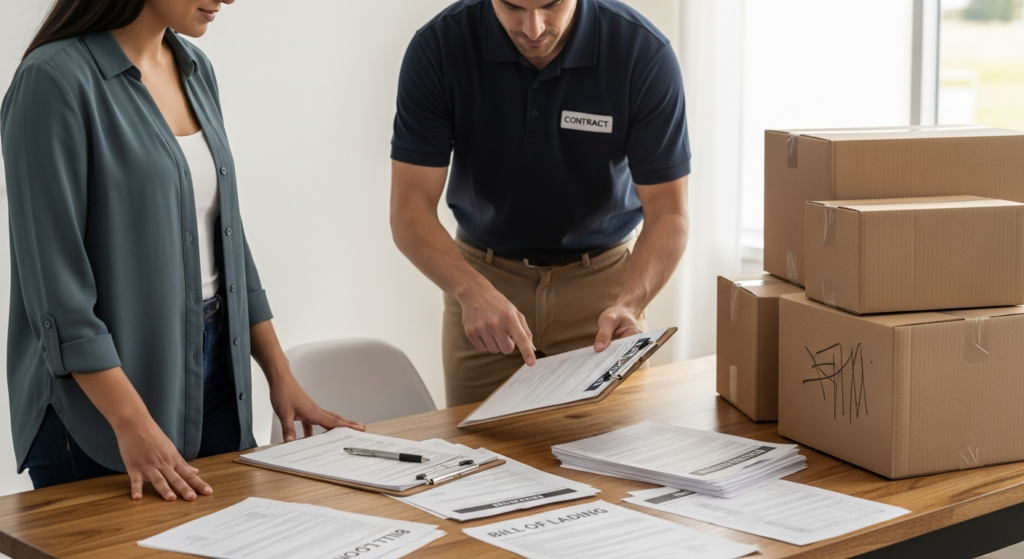
When a moving truck shows up at your home, it can feel like everything is happening at once: boxes, signatures, questions, and pressure to move fast. In the middle of all that, one document quietly controls almost everything about your rights if something goes wrong: the bill of lading.
Despite its old-fashioned name, the bill of lading is not just another piece of moving paperwork. For most U.S. household moves, it is the main contract between you and the carrier. It ties together your estimate, order for service, valuation choice, pickup and delivery terms, and the mover’s liability for loss, damage, and delay.
If your furniture arrives broken, items go missing, or you end up in a dispute over charges, the first thing any claims adjuster, regulator, or court will look at is usually the bill of lading. What is written there can strengthen your position—or quietly undermine it.
This guide explains what every mover must give you in the bill of lading, how it differs from the order for service and other moving paperwork, how to review it before signing, and how to use it later if you need to file a claim or challenge a bill. It is general information, not legal advice, and rules can differ for interstate versus intrastate or local moves, so always review your own documents and applicable law.
Key takeaways
- The bill of lading is usually the binding contract for your move and controls many of your rights if items are lost, damaged, or delayed.
- For interstate moves, federal rules (such as 49 CFR Part 375) require movers to include specific information on the bill of lading, including valuation and basic liability terms.
- The bill of lading is different from the estimate and order for service; if there is a conflict, the final signed bill of lading will often carry more weight.
- Never sign a blank or incomplete bill of lading. Confirm dates, addresses, valuation level, and any special promises in writing before the truck leaves.
- Keep copies of the bill of lading from both pickup and delivery; notes you make on the delivery section can be crucial evidence for a damage or delay claim.
- Organize your bill of lading together with the inventory, estimate, and photos so you can quickly support a claim or complaint if a dispute arises.
- If the mover refuses to provide a proper bill of lading, or pressures you to sign away rights, consider that a serious red flag and contact consumer-protection agencies.
What is a bill of lading in a household move?
In the moving industry, the bill of lading (often shortened to “BOL”) is the primary written contract between you and the carrier transporting your household goods. For interstate moves, federal law requires movers to issue a bill of lading for every shipment of household goods.
Think of it as the master document that ties all the other moving paperwork together:
- It references the estimate or binding/non-binding quote.
- It reflects the order for service or equivalent booking document.
- It lists the pickup and delivery addresses and dates (or spread dates).
- It identifies the carrier actually responsible for the shipment.
- It documents the valuation choice (for example, Released Value at 60 cents per pound vs. Full Value Protection).
- It may incorporate the mover’s tariff, terms and conditions, and arbitration program by reference.
For most consumers, the bill of lading is the first and last thing you sign with the crew. It should be present at both pickup and delivery. Some movers use a multi-page carbon form. Others use tablets and e-signatures. Either way, you should be able to obtain a readable copy of whatever you sign.
Because the bill of lading is a contract, it matters even if you never read it at the truck. When you later file a damage claim, dispute a charge, or file a complaint with the FMCSA, the language and checkboxes on the bill of lading can shape your options.
Interstate vs. intrastate and local moves
Rules differ depending on what kind of move you have:
- Interstate moves (state-to-state) are typically governed by federal law, including the Carmack Amendment and FMCSA regulations. These moves must have a bill of lading that meets specific minimum content requirements.
- Intrastate or local moves (within one state) may be regulated by your state’s public utilities commission, transportation department, consumer-protection division, or another agency. Many states also require a written bill of lading or moving contract, but the required details and your remedies may differ.
- International, military, and corporate moves often have additional or different documents, but there is usually still a core transport contract serving the same function as a bill of lading.
Always ask your mover which laws apply to your shipment and review any state-specific forms they provide.
Bill of lading vs. order for service vs. estimate
Consumers are often handed a stack of moving paperwork with confusing titles. Three documents matter the most:
- The estimate (or quote)
- The order for service
- The bill of lading
They are related, but not the same.
How each document works together
| Document | Main purpose | When you get it |
|---|---|---|
| Estimate (binding / non-binding) | Gives projected price and services based on inventory or weight; may be binding or non-binding. | Before the move is booked, often after an in-home or virtual survey. |
| Order for service | Authorizes the mover to perform the move under certain terms and estimated charges. | After you accept the estimate and schedule the move. |
| Bill of lading | Serves as the actual transport contract and receipt for your goods; documents liability, valuation, and final charges. | At pickup (and updated at delivery); must be signed by you or your representative. |
The estimate and order for service show what you expected to pay and what services you agreed to. The bill of lading is where those expectations become the operative contract at the time of loading.
When documents conflict
Disputes often arise when the bill of lading conflicts with earlier paperwork. For example:
- Your order for service notes Full Value Protection, but the bill of lading shows Released Value at 60 cents per pound.
- The estimate shows a flat binding price, but the bill of lading references hourly rates or weight-based charges that were never discussed.
- The order for service lists shuttle service included, but the bill of lading lists it as an extra that you are suddenly asked to sign for.
In these situations, a claims adjuster or judge will usually look at all the documents together. However, the signed bill of lading, as the final moving contract, may be treated as your acceptance of modified terms—unless you clearly objected or added notes at the time.
That is why you should treat the bill of lading as a moving contract, not a mere receipt.
What information must be on your bill of lading
For interstate household goods shipments, federal regulations (including portions of 49 CFR Part 375) require movers to include specific information on the bill of lading. State rules may impose similar or additional requirements for intrastate moves.
Exact wording and layout differ, but a compliant bill of lading for a typical interstate move usually includes the following categories.
Core identification details
- Carrier name and address (and sometimes MC or USDOT number)
- Your name and contact information
- Origin address and contact person
- Destination address and contact person
- Shipment or order number that matches your other moving paperwork
Schedule and routing
- Pickup date (or period / spread dates)
- Delivery date or delivery spread (for example, “7/10–7/14”)
- Any storage-in-transit (SIT) location, if applicable
- Notations for special routing or timing, if promised
Charges and payment terms
- Type of estimate (binding, non-binding, guaranteed not-to-exceed, etc.) or reference to the estimate document
- Rates or method used to calculate charges (weight, volume, time, tariffs)
- Any deposits already paid and balance due at delivery
- Acceptable forms of payment at delivery
- Notice of any additional services that may incur extra charges (shuttle, long carry, stairs, packing, waiting time, etc.)
Valuation and liability
This section is crucial if you experience loss or damage.
- Valuation option selected (for example, Full Value Protection, Released Value at 60 cents per pound per article)
- Any declared value for the entire shipment or per pound
- Deductible amount, if any, for Full Value Protection
- Language referencing the carrier’s tariff, limitation of liability, and claim filing requirements
Signatures and acknowledgments
- Signature of the carrier or its agent
- Your signature (or the signature of your designated representative) at pickup
- Space for your signature and notations at delivery
- Statements that you received the “Your Rights and Responsibilities When You Move” booklet and any arbitration brochure (for interstate moves)
Example information layout
| Section on BOL | Typical contents | Why it matters later |
|---|---|---|
| Shipper / Consignee Info | Names, phone numbers, email, origin and destination addresses. | Establishes who can file claims and receive notices. |
| Valuation Checkbox | Which coverage option you picked and any declared value. | Sets maximum payout and how claims are calculated. |
| Estimate Reference | Binding vs. non-binding and estimate number. | Helps challenge overcharges and unauthorized extras. |
If your bill of lading is missing basic information, looks handwritten with critical details left blank, or does not match the company you thought you hired, treat that as a serious warning sign and take photos of every page.
What to check before you sign
Most consumers sign the bill of lading under time pressure while crews are waiting to start loading. That is exactly when costly mistakes are made. You are allowed to slow down and read the document.
Five-minute pre-sign checklist
- Names match: Confirm the company name on the bill of lading matches the mover you hired and any name on the truck or uniforms. If the actual carrier is different from the broker you spoke with, that should be clearly identified.
- Addresses are correct: Check that origin and destination addresses are accurate, including apartment numbers, gate codes, and contact phones.
- Dates and windows: Make sure the pickup and delivery dates or spread are what you were told in writing. If there is a specific “no earlier than” or “no later than” date, confirm it appears.
- Valuation is what you chose: Look at the valuation section. Is the correct option checked, and is any declared value amount accurate? If you planned on Full Value Protection, make sure it does not show Released Value instead.
- Estimate type and charges: Confirm whether the move is binding, non-binding, or another type as promised. The bill of lading should reference the same estimate number and basic charges.
Sample wording for clarifying questions
If something does not match your earlier moving contract or order for service, say so on the spot. You can use simple, clear language:
“Before I sign, this bill of lading shows Released Value at 60 cents per pound. My order for service and estimate specify Full Value Protection. Please correct this to match the earlier paperwork or note my objection in writing.”
“This delivery window is different from what I have in my confirmation email. I am only authorizing this move based on the prior written dates. Please update the dates or write on the bill of lading that I do not agree to a later delivery.”
If the crew refuses to correct obvious discrepancies, you can write your own note near your signature, such as:
“Signed under protest as to valuation option and delivery dates; see attached estimate/order for service dated 5/20.”
Then take photographs of the bill of lading and your earlier moving paperwork before the truck leaves.
The delivery side of the bill of lading
Many consumers focus only on the pickup signature and forget about the delivery side of the bill of lading. But what happens at delivery can be just as important for any future damage or delay claim.
What happens at delivery
- The driver or crew leader will typically present the bill of lading again, showing final charges, any additional services, and the actual weight (for weight-based moves).
- You may be asked to sign a delivery receipt or second section of the bill of lading, acknowledging that your shipment has been delivered.
- There is usually a space for you to note visible loss, damage, or missing cartons.
Do not feel rushed. This is your chance to create contemporaneous written evidence of issues.
What to write if there is damage or loss
Your wording does not have to be perfect; it just needs to be clear that you noticed problems at delivery. Some examples:
- “Sofa leg broken; dining table scratched; several boxes crushed. Full inspection not yet completed.”
- “Itemized damage list to follow after unpacking. Noted visible crushed cartons and missing box #32 from inventory.”
- “Delivery late beyond 7/10–7/14 window; arrived 7/18.”
After you write your notes, take photos of the exact language you wrote on the bill of lading and keep a copy. Claims adjusters routinely rely on these notes to confirm that damage was not fabricated later.
Do you have to note every single scratch?
Ideally, you will compare each delivered item to the inventory and note all obvious damages. In reality, that is not always practical, especially on large moves.
At minimum, try to:
- Note any major damage you can see (broken items, crushed boxes, missing pieces).
- State that a full inspection is pending and that you reserve the right to file a claim for additional items discovered later.
Later, when you submit your damage claim, reference the bill of lading delivery notes and provide photos, inventory numbers, and repair/replacement estimates.
Paper vs. digital bills of lading
Many movers are switching from carbon-copy paper forms to tablets and e-signatures. Both are valid if the content is compliant, but digital formats can introduce new pitfalls.
Common issues with digital BOLs
| Issue | Risk to you | How to protect yourself |
|---|---|---|
| Tiny text on a tablet | You sign without clearly seeing valuation, dates, and charges. | Ask them to enlarge the text; request an emailed PDF before signing if possible. |
| Only summary page visible | You never see referenced terms and conditions or full tariff language. | Ask for the full bill of lading package, not just the signature screen. |
| Delayed access to copy | You cannot prove what you signed if disputes arise. | Insist on an emailed or printed copy on the same day and save it to multiple places. |
You are entitled to a copy of whatever you sign. If the mover says they will email it “later” and nothing arrives within a reasonable time, follow up in writing and document your requests.
How your bill of lading helps (or hurts) a claim
When you file a claim for damage, loss, or delay, the bill of lading becomes a central piece of evidence. Claims adjusters and arbitrators use it to reconstruct what was agreed, who was responsible, and whether required procedures were followed.
Typical questions a claims adjuster asks
- Does the bill of lading show the correct valuation option? If not, did the consumer object or note anything?
- Did the mover list any pre-existing damage on the inventory or bill of lading that might reduce liability?
- Are the shipment dates and delivery window consistent with the consumer’s complaint about delay?
- Did the customer note damage or missing items at delivery on the bill of lading?
- Was the claim filed within the time limits referenced in the bill of lading or tariff?
Evidence table: how the BOL supports your position
| Claim issue | Helpful BOL entries | How it strengthens your file |
|---|---|---|
| Furniture arrived broken | Delivery notes mentioning broken items; no pre-existing damage notations at pickup. | Shows damage occurred during transit rather than before pickup. |
| Missing cartons | Bill of lading lists total carton count at loading; delivery notes fewer cartons received. | Helps prove loss and shifts burden to mover to explain discrepancy. |
| Late delivery | Delivery window printed on BOL and your note that the truck arrived beyond that window. | Supports any delay-related claim or complaint with regulators. |
On the other hand, if the mover can point to the bill of lading and show that you signed for a lower valuation, accepted certain limitations, or did not note obvious problems at delivery, your negotiating leverage may be weaker.
Checklist: documents to submit with a claim
When you prepare a claim, include:
- Pickup and delivery pages of the bill of lading (front and back)
- Order for service and any signed estimate
- Household goods inventory pages with tag numbers
- Photos of items before and after the move, if available
- Photos of your notes on the bill of lading at delivery
- Repair estimates, receipts, or online replacement screenshots
Presenting a complete, organized package shows the mover or adjuster that you understand the process and are ready to support your numbers.
Using the bill of lading in charges and overbilling disputes
Not all disputes involve damage. Many consumers contest surprise charges or major differences between the original quote and the final bill. The bill of lading is often the key document for those arguments.
Common billing disputes
- Being charged for extra services (shuttle, long carry, packing) you did not request or authorize.
- Being billed for a higher weight or volume than seems realistic.
- Being asked to pay more than a binding estimate or more than the allowed percentage over a non-binding estimate at delivery on interstate moves.
To challenge these, compare the bill of lading to your estimate and order for service.
Charges vs. earlier paperwork table
| Step | What to compare | Possible argument |
|---|---|---|
| 1. Estimate vs. BOL | Estimate type and expected charges vs. BOL entries for contract type and tariffs. | “BOL must reflect binding estimate terms I accepted earlier.” |
| 2. Services listed | Services included on estimate vs. add-ons on BOL. | “These add-ons were not disclosed or authorized in writing.” |
| 3. Weights and scale tickets | Weight on BOL vs. scale tickets and inventory volume. | “Weight appears inflated; please provide certified scale tickets.” |
Sample wording for a written billing dispute
Using calm, precise language is more effective than emotional accusations. For example:
“On the attached bill of lading for Order #12345, the final charges include a $650 shuttle fee and $300 long-carry fee. These services were not listed on my binding estimate or order for service and were not clearly disclosed or agreed to in writing at pickup. Please adjust the bill to reflect the original binding estimate and provide a revised, itemized statement.”
Send this type of dispute by email (and certified mail if the amount is significant), attaching your moving paperwork, and keep copies for any later arbitration or small claims filing.
How to organize your moving paperwork
Even the strongest bill of lading will not help you if you cannot find it when you need it. Claims and disputes often fail because consumers cannot produce their documents on time.
Simple organization system
- Create a single digital folder named something like “2026-07 Smith Family Move”.
- Scan or photograph the bill of lading (pickup and delivery), order for service, estimate, inventory, and any emails or texts with the mover.
- Save each file with clear names: “BOL-pickup-2026-07-01.pdf”, “Inventory-page1.jpg”, etc.
- Back up the folder to cloud storage or another device.
- Keep the physical originals in a labeled envelope or binder.
Checklist: paperwork to keep together
- Estimate(s) – all versions, including updated inventories
- Signed order for service or moving contract
- Bill of lading – all pages, both pickup and delivery sides
- Household goods inventory sheets
- Receipts for packing materials, special crating, or extra insurance
- Photos and videos of items before and after the move
- Claim forms, emails, and letters exchanged with the mover
- Any arbitration, FMCSA, or state agency complaint filings
When you later need to use a resource like The First 72 Hours After a Damaged Move: A Survival Checklist or How to Document Moving Damage for a Strong Claim, having your bill of lading organized from day one will make following those steps much easier.
Common bill of lading mistakes to avoid
Many of the worst moving disputes could have been softened or prevented if the consumer had handled the bill of lading differently at the start.
Mistake vs. prevention table
| Common mistake | Why it is a problem | Better approach |
|---|---|---|
| Signing a blank or mostly blank BOL at pickup | Mover could later fill in unfavorable terms or extra charges. | Insist that all key sections be completed before signing. |
| Ignoring the valuation section | You may accidentally agree to minimal protection (60 cents per pound). | Confirm valuation option matches your earlier decision and documents. |
| Not noting obvious damage on delivery | Mover may argue damage did not happen during transit. | Write brief, specific notes about visible damage and missing items. |
| Throwing away the BOL after the move | You may not be able to prove what was agreed if disputes arise later. | Scan and store digital copies in at least two locations. |
What not to sign or say too early
- Do not sign any document titled “claim release,” “settlement and release,” or similar within hours of delivery if you have not fully inspected your goods.
- Do not sign a statement that says “shipment received in good condition” if you clearly see broken or missing items; modify the wording or add your own notes.
- Do not verbally agree that damage “doesn’t matter” or “isn’t a big deal” while the crew is present. Keep your comments factual and neutral.
It is better to politely say:
“I am noting what I see today on the bill of lading and will complete a full inspection as I unpack. I will follow your claim process if I find additional problems.”
Using the bill of lading to support your claim amount
When you submit a claim, you will need to attach a dollar amount to each damaged or missing item. The bill of lading does not set those amounts directly, but it influences how they are calculated.
Valuation and payout examples
Suppose your bill of lading shows:
- Shipment weight: 6,000 lbs
- Valuation option: Released Value at 60 cents per pound per article
If a 100-pound dresser is destroyed beyond repair, the mover’s maximum liability under that valuation might be:
100 lbs × $0.60 = $60
In contrast, under Full Value Protection, the mover might be obligated (subject to deductible and tariff rules) to repair, replace with similar item, or pay the current market replacement cost, possibly several hundred dollars.
Valuation scenarios table
| Scenario | What BOL shows | Effect on claim |
|---|---|---|
| High-value item broken | Released Value at 60¢/lb, no separate high-value inventory. | Recovery may be far below actual value; BOL supports mover’s limit. |
| Electronics damaged | Full Value Protection with declared shipment value and no deductible. | You can argue for repair or replacement cost, less depreciation if tariff allows. |
| Multiple small items missing | Total shipment weight and valuation option on BOL support total coverage limit. | Helps show overall cap and that claim amount is within that cap. |
Using the BOL in settlement negotiations
When you receive a low settlement offer, compare it to the valuation and shipment details on your bill of lading. Your response might say, for example:
“The bill of lading for my shipment (Order #12345) reflects Full Value Protection with a declared value of $60,000 and no deductible. The attached repair estimate for my damaged dining table is $750. The proposed settlement of $150 does not align with the valuation level documented in the bill of lading. Please reconsider and explain how this amount was calculated under your tariff.”
Referencing the bill of lading anchors your argument in the written contract rather than emotion.
When and how to escalate a dispute
Sometimes, even a carefully prepared claim supported by a clear bill of lading does not produce a fair-seeming result. At that point, you may consider escalation options. The right path depends on whether your move was interstate or intrastate and what your bill of lading or tariff says about dispute resolution.
Typical escalation pathways
- Internal appeal: Many carriers allow a second review if you respond in writing and include additional documentation.
- Arbitration: For interstate moves, movers are generally required to offer a neutral arbitration program for certain disputes, especially over charges and some damage claims. Your bill of lading or accompanying documents should describe how to request arbitration.
- FMCSA complaint: You can file a complaint with the Federal Motor Carrier Safety Administration’s National Consumer Complaint Database for interstate moves. This will not directly decide your claim, but it can trigger follow-up and may motivate a mover to resolve issues.
- State consumer or utilities agency: For intrastate moves, your state’s consumer-protection office or public utilities/transportation commission may take complaints or investigate patterns of abuse.
- Small claims court or attorney review: In some cases, particularly where the amount in dispute is within your local small claims limits, you may consider legal action. Your bill of lading will be a central exhibit.
What your bill of lading may say about disputes
Many bills of lading contain sections about:
- Claim filing deadlines (sometimes 9 months for written claims on interstate moves, but check your documents)
- Time limits for filing suit after a claim decision
- Whether arbitration is mandatory or optional
- Which state’s law applies and where lawsuits must be filed
These clauses can be very important. Always read them and, if necessary, consult a qualified attorney about how they affect your specific situation.
Frequently asked questions
Is the bill of lading the same as a moving contract?
In most household moves, especially interstate shipments, the bill of lading functions as the main moving contract. It incorporates your estimate, order for service, and the mover’s tariff terms. Some intrastate moves may use a separate moving contract, but the bill of lading still serves as the key transport document.
Does every mover have to give me a bill of lading?
For interstate household goods moves, federal regulations require a bill of lading for every shipment. Many states also require similar paperwork for intrastate moves. If a mover refuses to provide one, or gives you only a handwritten note with no details, that is a serious red flag.
When do I get the bill of lading?
You should receive the bill of lading at or before pickup, and you should see it again at delivery. With digital systems, you might receive it by email once you sign on a tablet. Always insist on a copy on the same day you sign.
Can I change the bill of lading after I sign it?
You generally cannot unilaterally change a signed bill of lading later, but you can add written notes at the time of signing, or send follow-up emails documenting any disagreements. Those notes and emails can be useful if a dispute arises.
What if the bill of lading shows a different valuation than I requested?
Raise the issue immediately at pickup. Ask the crew to correct the valuation section to match your order for service or written estimate. If they refuse, note your objection in writing on the bill of lading, take photos, and follow up with the company office the same day.
Do I have to write damage on the bill of lading at delivery?
You are not legally required to, but it is strongly recommended. Brief notes about visible damage or missing items on the delivery receipt can make your later claim much easier to prove and may prevent the mover from arguing that problems happened after delivery.
How long should I keep my bill of lading?
Keep it for at least as long as your claim filing and legal time limits, which can run many months or longer depending on your contract and applicable law. As a practical rule, keep all moving paperwork for at least two to three years in case issues appear later.
What if the mover never sent me a copy of the bill of lading?
Write or email the mover promptly and request a copy, referencing your order number, dates, and addresses. If they still refuse or delay, document your request and consider contacting the FMCSA (for interstate moves) or your state consumer-protection agency.
Can I use the bill of lading in small claims court?
Yes. If you decide to pursue a dispute in small claims or another court, the bill of lading will usually be one of the most important documents. Bring copies of it along with your estimate, order for service, inventory, photos, and claim correspondence.
Does signing the bill of lading mean I waive all rights?
Signing acknowledges the terms and that the mover has received or delivered your goods. It does not automatically waive your right to file claims within the time limits listed. However, separate release or settlement documents you are asked to sign later could waive rights, so read anything new carefully before signing.
Official sources & further reading
- FMCSA Protect Your Move – Official federal information on interstate household moves, including rights and responsibilities.
- FMCSA National Consumer Complaint Database – Portal for filing complaints about interstate movers.
- 49 CFR Part 370 – Federal rules on processing claims for loss and damage to property.
- 49 CFR Part 375 – Federal regulations for transportation of household goods in interstate commerce, including bills of lading and estimates.
- Your state’s consumer-protection or public utilities commission website – Many states publish guidance on intrastate moving contracts and complaint processes.
- The “Your Rights and Responsibilities When You Move” booklet – Movers must provide this for interstate moves; it explains contracts, estimates, and claims.
Related guides
This guide is general information, not legal advice. For a specific dispute, consult a qualified attorney or your state consumer-protection office.