
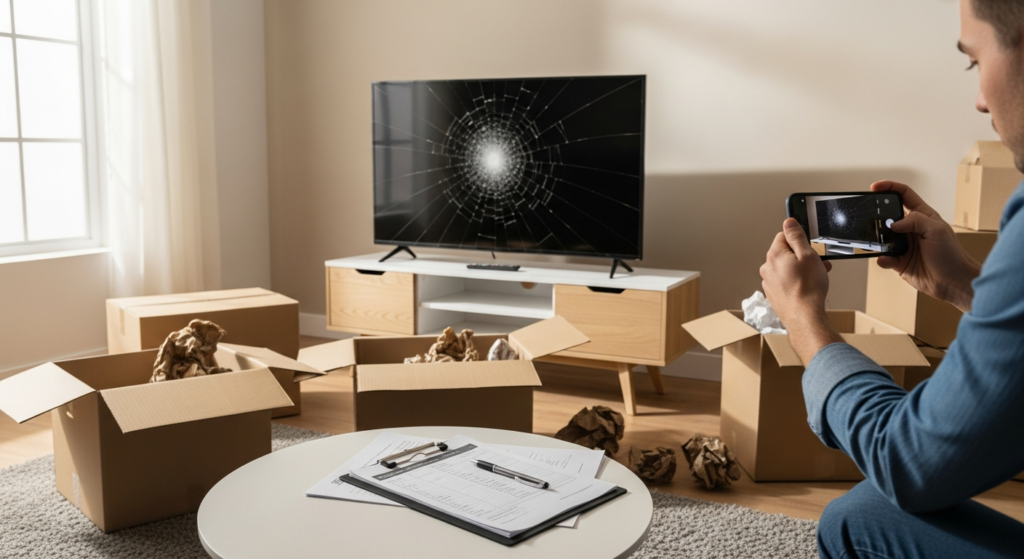
Finding a cracked TV screen, a dead soundbar, or a fried gaming console after a move is more than frustrating. Electronics are expensive, fragile, and often the most painful items to lose. The good news is that you can usually ask the moving company to pay something for the damage, but what you can claim and what you can realistically recover depends on your paperwork, your evidence, and how you present your case.
This guide walks you through exactly what to do when a TV or other electronics are damaged in a move: what to document, how to use serial number proof, how valuation coverage and depreciation affect the payout, and how to respond if the company offers a low settlement or blames “inherent vice.”
We will focus on practical steps you can take right now: photos to capture, documents to pull, how to describe damage on delivery receipts, how to calculate a reasonable dollar amount, and how to keep your file organized so you are ready if you need to escalate to arbitration, a complaint with the Federal Motor Carrier Safety Administration (FMCSA), or other options.
Rules for claims can differ depending on whether your shipment was interstate (state-to-state), intrastate (within one state), local, corporate, or international. Always review your bill of lading, estimate, and the mover’s tariff and claim form for deadlines and specific instructions. This guide is general information, not legal advice.
Key takeaways
- Do not power on a visibly damaged TV or device; photograph everything first, including the serial number and how it was packed or delivered.
- Your valuation coverage (full value vs. released value) usually determines the maximum amount you can recover for electronics damage.
- Serial number proof, model details, receipts, and repair estimates are critical for an electronics damage claim.
- Describe damage accurately on the household goods inventory and delivery receipt before signing anything “clear” or “received in good condition.”
- Keep a single organized file with photos, videos, screenshots, invoices, and all communication with the mover or claims company.
- You can push back on low offers by challenging improper depreciation, showing current replacement costs, and providing better documentation.
- If negotiation fails, you may have options through FMCSA complaints, required arbitration programs, state agencies, or small claims court, depending on your move.
First steps when you find a broken TV or electronics
What you do in the first hours and days after discovering damage can make or break your electronics damage claim. Movers and claim adjusters pay very close attention to whether you reported issues quickly and how thoroughly you documented what you found.
Step 1: Stop and document before you plug anything in
Electronics often suffer internal damage that is not immediately obvious. If you power on a device and it shorts out, the mover may argue the failure was caused by your own handling after delivery.
- Do not power on a TV, computer, or other device that appears bent, cracked, dented, or rattling inside.
- Do not throw away boxes, packing, foam, or blankets that were around the damaged item.
- Do not move items out of the room until you photograph their position.
Tip: Take a short video slowly panning the room and zooming in on damaged items before you touch anything.
Step 2: Note damage on delivery paperwork if you are still with the crew
If the crew is still present when you notice the broken TV or electronics, use that moment. Once you sign everything “clear” it becomes harder to argue the damage occurred in transit.
- Ask for the household goods inventory or delivery receipt.
- Next to the specific line item (e.g., “TV 55 inch”), write a short note such as “cracked screen on delivery” or “not powering on after delivery”.
- Initial next to your note, and request that the driver initial as well if possible.
- Take a photo of the signed page for your records.
Step 3: If you already signed, report in writing as soon as possible
If you discovered the issue after the movers left, do not panic. Many claims are made after the fact, especially for electronics that are not set up immediately. But timing still matters.
- Review your bill of lading and the mover’s claim instructions for reporting deadlines.
- Email the mover’s customer service and claims address as soon as you discover the issue.
- Include photos, your order or bill of lading number, and a short, factual description.
Sample wording to report damage quickly by email:
“I am writing to report damage discovered on my recent shipment, Order/BOL #123456. My 65-inch Samsung TV (Serial #XYZ123456) arrived with a cracked screen and does not power on. It was in Box #22 labeled ‘Living Room TV’ on the inventory. I have attached photos of the damage and how it was received. Please confirm the claim process and deadlines so I can submit a formal claim.”
How to document electronics damage the right way
Strong proof can be the difference between a full-value repair or replacement (if your coverage allows) and a token offer. An electronics damage claim is often easier to dispute than a scratched dresser because you can combine visual evidence with serial number proof and technical opinions.
Photos and videos you should capture
- Wide shots of the room showing how boxes and items were placed on delivery.
- Medium shots of the damaged TV or device in context (stand, wall mount, floor, truck ramp, etc.).
- Close-ups of cracks, dents, broken ports, bent frames, or damaged cords.
- Close-ups of labels, brand logos, and model markings.
- Close-ups of the shipping carton if there is visible crush damage, punctures, or water marks.
- Short videos showing the device failing to power on or producing distorted images or sound.
Documents and digital proof that help your case
- Original receipts or online order confirmations showing the purchase price and date.
- Credit card or bank statements (with other lines redacted) if you lack a detailed receipt.
- Warranty registrations or manufacturer support emails.
- Home insurance schedules listing major electronics (if available).
- Previous repair invoices that show the item was recently serviced and functioning.
- Screenshots of current replacement pricing from major retailers.
Evidence table: what matters most for broken TVs and electronics
| Evidence type | Why it helps | Practical example |
|---|---|---|
| Serial number photos | Proves identity and ties the damaged item to your specific unit. | Photo showing TV rear label with serial number and brand. |
| Pre-move condition photos (if available) | Shows the same device working and undamaged before pickup. | Screenshot of TV in use in your old home taken a few days before move. |
| Receipts or purchase proof | Establishes age, model, and original value for depreciation and valuation. | Online order confirmation from Best Buy with date and price. |
| Repair estimates | Shows cost to restore function vs. replacement, required under some tariffs. | Quote from local TV repair shop stating screen replacement cost. |
| Inventory and delivery documents | Links the item to the shipment and notes damage on delivery if recorded. | Inventory line: “TV 65″ LED, carton dented” signed at delivery. |
Using serial numbers and model info as proof
Electronics are uniquely identifiable. That works in your favor when you structure your electronics damage claim using serial number proof and model details.
Where to find serial numbers
- TVs: Label on the back, side, or sometimes in the on-screen menu (for smart TVs).
- Laptops and desktops: Bottom casing, under battery, or on a back/side label.
- Game consoles: Rear or bottom label near power/HDMI ports.
- Appliances: Door frame, rear panel, or inside edge (for dishwashers, washers, dryers).
- Sound systems and receivers: Rear panel near inputs.
How serial numbers strengthen your case
- Show that the damaged item is the same unit you purchased and registered.
- Allow you to pull manufacturer specs, original MSRP, and issue history.
- Help a repair shop pull exact part numbers and costs.
- Limit arguments about “that was an old unit” or “this is a different TV.”
Tip: If you have older photos or emails from when you first bought the TV or device, look for serial numbers or model numbers there and include them in your claim file.
Which moving documents matter for electronics claims
When you claim a broken TV or damaged appliances from a move, the moving company will almost always refer to your paperwork: the bill of lading, order for service, inventory, and valuation election. These documents control their liability limits and their defenses.
Key documents to pull now
- Bill of lading: The main contract for your shipment. It usually lists valuation coverage, any special notations about electronics, and your move dates.
- Order for service / estimate: Shows whether you were quoted full value protection or released value (e.g., $0.60 per pound per article).
- Household goods inventory: Lists your TV, computers, stereo, and other electronics, often with condition codes.
- High value inventory (if any): Should list high-dollar items you declared, which may include expensive TVs or sound systems.
- Delivery receipt / driver’s pages: Where you might have noted damage at the time of delivery.
- Valuation addendum: Sometimes a separate page you signed choosing full value, deductible options, or released value.
Understanding condition codes and notations
Inventories often use two-letter codes to show pre-existing conditions (e.g., SC for scratched, BR for broken, BE for bent). For electronics, some companies mark “PBO” (packed by owner) to shift responsibility for internal damage inside the box.
Review how your TVs and electronics were described before the move:
- If your TV was marked “BR” (broken) or “SC” (scratched) at origin, the mover may argue the damage was pre-existing unless you have strong contrary evidence.
- If your TV was properly marked as good condition but the box was marked “crushed” on delivery, that can support a transit damage claim.
- If inventory is missing serial numbers, your serial number photos become even more important.
Valuation coverage and what it means for your payout
One of the most confusing parts of an electronics damage claim is valuation coverage. Valuation is not the same as insurance; it is the level of liability the mover agreed to assume in the bill of lading and their tariff.
For interstate moves regulated by FMCSA, federal rules generally require movers to offer at least two levels of liability: full value protection and released value ($0.60 per pound per article). Intrastate and local moves may be governed by state rules or tariffs with similar or different options.
Common coverage options for electronics
| Coverage type | How it works | Impact on electronics claim |
|---|---|---|
| Full value protection (FVP) | Mover is generally liable for repair, replacement with like kind/quality, or a cash settlement up to the declared value, subject to tariff rules and deductibles. | You may receive repair cost or a replacement TV/ device of similar type, with depreciation sometimes limited by tariff, but subject to exclusions. |
| Released value (e.g., $0.60/lb) | Mover’s liability is limited to a set amount per pound per article, regardless of actual value. | A 50 lb TV might only yield a $30 settlement even if the TV cost $800. |
| Third-party moving insurance | Separate policy purchased from an insurance company, not the mover, with its own terms and deductibles. | You may need to file with both the mover (for valuation) and the insurer; coordination of benefits matters. |
| Intrastate/state-specific programs | Some states require specific minimum levels or arbitration programs for in-state moves. | Check state rules or public utilities commission if your move was within one state. |
Always confirm which coverage you actually chose and signed for, not just what the salesperson mentioned. The valuation section on your bill of lading or a separate valuation addendum usually controls.
How to calculate what to claim for a broken TV or device
Once you know your coverage level, you can estimate what to claim. For full value protection, you usually need to show either the reasonable cost to repair or the reasonable cost to replace with a similar item. For released value coverage, you still list full values, but the final payout will be capped by weight-based liability.
Information to gather for each damaged electronic item
- Item description (brand, model, size, features).
- Serial number.
- Date of purchase and original price (if known).
- Condition just before the move (working, minor scratches, like new, etc.).
- Nature of damage (cracked screen, no power, distorted sound, broken ports, etc.).
- Repair feasibility and estimated cost.
- Current replacement cost for comparable item.
- Weight (for released value calculations).
Sample calculation table: full value vs. released value
| Item | Key numbers | Potential payout scenarios |
|---|---|---|
| 65″ 4K TV | Weight: 55 lbs; Original price: $900; Current similar replacement: $700; Repair estimate: $650 | Under FVP: Mover may pay for repair ($650) or replacement (~$700), subject to tariff and any deductible. Under released value: 55 lbs x $0.60 = $33 max. |
| Soundbar & subwoofer | Weight: 20 lbs; Original price: $400; Current replacement: $350; Not repairable economically. | Under FVP: Likely replacement cost (~$350). Under released value: 20 lbs x $0.60 = $12 max. |
| Game console | Weight: 10 lbs; Original price: $500; Current replacement: $450; Repair estimate: $300 | Under FVP: Repair ($300) or replacement (~$450). Under released value: 10 lbs x $0.60 = $6 max. |
Sample wording in your claim form for a TV:
“Item: Samsung 65-inch 4K LED TV, Model UN65XYZ, Serial #ABC123. Purchased 06/2021 for $899.99 (receipt attached). Condition before move: fully functional, no visible damage. Damage discovered 03/15/2026: cracked panel across lower-left corner, screen flickering, TV will not stay powered on (photos and video attached). Local repair shop states screen replacement not economical; quote attached for $650. Comparable current replacement cost from major retailer is $699.99 (screenshot attached).”
Packing, “inherent vice,” and how movers try to deny electronics claims
Electronics are fragile, and many movers respond to an electronics damage claim by arguing improper packing or “inherent vice” (a built-in weakness of the item) caused the issue, not their handling. Understanding these arguments helps you prepare counter-evidence.
Common defenses used against electronics claims
| Mover argument | What it means | Possible counter |
|---|---|---|
| “Packed by owner (PBO)” | They claim the box was packed by you, so they are not responsible for internal damage absent obvious external damage. | Show evidence that crew packed the item, or that the carton was visibly crushed or punctured, suggesting rough handling. |
| “Inherent vice” or “mechanical failure” | They argue the item failed due to age, prior wear, or internal defect, not transit damage. | Provide proof it worked just before the move (videos, service records), especially if failure is linked to visible impact damage. |
| “No external damage” to carton | They say the box appears fine, so they infer damage existed before or is unrelated. | Show photos from unboxing, report from a technician stating likely drop or impact, or demonstrate that original foam packaging was missing/changed. |
| “Item older / heavily used” | They argue age and wear justify a lower value or that damage was pre-existing. | Acknowledge age but insist on fair value; provide receipts and show the item was functional and useful. |
Every move is different, and federal and state rules may apply differently. Review the mover’s tariff and any applicable regulations for specific exclusions and limitations.
How to organize your claim file for electronics damage
A clear, well-organized file makes you look credible and makes it harder for the claims department to overlook important details. Think like an adjuster: can someone who has never seen your TV understand exactly what happened from your file?
Suggested folder structure
- 01 Paperwork: Bill of lading, estimates, inventory, valuation addendum, delivery documents.
- 02 Photos & video: Subfolders for each damaged item, labeled with model names.
- 03 Receipts & purchase proof: PDFs or screenshots of invoices and statements.
- 04 Estimates: Repair quotes, valuation reports, technician opinions.
- 05 Correspondence: Emails with the mover, claims company, and any third parties.
- 06 Claim forms: Drafts and final submitted claim with any attachments.
Tracking each damaged item
Create a simple spreadsheet or table listing each electronics item and what documentation you have. This also helps you spot gaps before the mover does.
| Item | Proof on hand | Missing items to gather |
|---|---|---|
| 65″ LG OLED TV | Photos, serial number, purchase receipt, repair estimate, inventory line, delivery note. | Screenshot of current replacement price from two retailers. |
| PlayStation console | Photos, serial number, pre-move video playing a game, bank statement for purchase. | Written repair opinion from local electronics shop. |
| Washer/dryer pair | Photos, serial label photos, inventory, delivery receipt noting dented side panel. | Plumber/appliance tech report explaining leak caused by transit damage. |
Submitting your electronics damage claim step by step
Each mover or carrier may have its own claim form and online portal, but the overall process is similar. For interstate carriers, claim handling is often guided by the Carmack Amendment and regulations such as 49 CFR Part 370, but you should always confirm requirements in the carrier’s tariff and on the claim form itself.
Step-by-step process
- Check deadlines: Look on the back of your bill of lading, in the mover’s tariff, or on the claim form for the time limit to file a written claim. Many carriers require notice within a set number of months after delivery.
- Obtain the official claim form: This may be emailed to you, provided as a link, or included in your paperwork folder.
- List each damaged electronic item separately: Provide item descriptions, serial numbers, and detailed damage descriptions.
- Attach evidence: Many forms allow attachments. Include photos, receipts, estimates, and screenshots. If you must mail documents, keep copies.
- State specific amounts: For each item, list repair cost or replacement cost, depending on your coverage rules.
- Submit in writing: Follow the method required (online portal, email, mail). Keep confirmation of submission.
- Calendar follow-up dates: Note when the mover acknowledges receipt and any target dates for their decision, based on their written policy.
Sample wording for the item description portion of a claim form:
“Item #1: LG 55-inch 4K TV, Model 55UNXYZ, Serial #12345ABC. Box number on inventory: Carton #18. Described on inventory as ‘TV 55, good condition.’ On delivery, box #18 had crushed corner, noted ‘crushed’ on delivery receipt. After unpacking, screen had multiple cracks, TV will not display image (photos attached). Repair shop advises replacement; estimate and written statement attached. Claimed amount: $549.99 (current comparable replacement).”
How movers and adjusters typically respond
After you submit your electronics damage claim, you will usually receive an acknowledgment, then a request for more information, followed by one of several types of responses. Understanding these patterns helps you stay ahead.
Common stages in the responder’s process
- Acknowledgment: A short email or letter confirming receipt and assigning a claim number.
- Information request: They may ask for additional photos, receipts, or to inspect the items in person or via virtual inspection.
- Investigation: Review of the inventory, driver’s notes, weight tickets, and any handling concerns. They may ask the driver for a statement.
- Coverage review: Adjuster checks your valuation election, any deductible, and tariff rules that apply to electronics.
- Settlement offer: A written offer for repair, replacement, or cash, often with a breakdown of depreciation or weight-based liability.
Keep all communication polite and factual. If an adjuster calls by phone, follow up with an email summarizing what was discussed so you have a written record.
How to counter a low settlement offer for broken electronics
Low offers for a broken TV or damaged appliances are common, especially if you lack documentation or the mover applies heavy depreciation. You can often improve the outcome by responding in writing with specific objections and updated proof.
Typical reasons for low electronics offers
- Valuation was released value ($0.60 per pound), which limits their liability.
- The adjuster applied aggressive depreciation, assuming a short useful life.
- They used a cheaper or older model as the replacement reference.
- They questioned causation, suggesting the item failed due to age or pre-existing issues.
- They claim improper packing or PBO status.
Strategies to push back
- Confirm that they applied the correct valuation coverage and weight for each item.
- Ask for the basis of their depreciation or replacement pricing in writing.
- Provide updated replacement pricing from multiple mainstream retailers.
- Provide technician statements linking the failure to impact or handling, not age alone.
- Point out any inconsistencies in the inventory or delivery notes that support your side.
Sample wording to respond to a low offer:
“Thank you for your settlement letter dated 04/20/2026 regarding Claim #78910. I appreciate your review, but I must respectfully dispute the proposed payment of $150 for my LG 65-inch 4K TV. Your letter states that you applied a 70% depreciation based on age. The TV was purchased less than three years before the move and was fully functional with no defects, as shown in the enclosed pre-move photos and service history. Current replacement cost for a comparable model from two major retailers averages $799.99 (screenshots attached). I request that you reconsider the depreciation applied and adjust the settlement to more accurately reflect the item’s value under my full value protection coverage.”
What not to sign or say too early
When you are stressed about a broken TV or electronics, it is easy to sign away important rights without realizing it. Slow down and read everything.
Be cautious with these documents
- Settlement release forms: Do not sign a release accepting a payment unless you understand whether it is final for some or all items, and whether it covers only certain damages or all claims from the move.
- Blank or vague forms: Avoid signing forms with blank spaces, unclear terms, or statements that all goods are received in perfect condition if you know items are damaged.
- Statements blaming yourself: Do not volunteer comments like “I probably packed it wrong” or “It was old anyway” in writing.
It is reasonable to say you are still assessing damage. If you need additional time to inspect electronics thoroughly, put that in writing on the delivery paperwork if possible.
When and how to escalate: complaints, arbitration, and court
If you feel your electronics damage claim was not handled fairly, you may have escalation options depending on your move type, paperwork, and state.
Internal appeal or second look
- Ask for a supervisor review at the moving company or claims company.
- Provide a concise summary of your position, with organized documentation attached.
- Identify specific errors (e.g., wrong coverage, wrong weight, misapplied depreciation).
FMCSA complaint (for interstate moves)
For interstate shipments, you can submit a complaint to the FMCSA’s National Consumer Complaint Database. While FMCSA does not resolve individual claims, complaints can encourage carriers to respond more carefully and may support broader enforcement efforts.
Arbitration
Interstate household-goods carriers are generally required to offer a neutral arbitration program for certain disputes, including loss and damage claims within defined dollar ranges. Check your bill of lading and the mover’s arbitration brochure for details on:
- When you can demand arbitration.
- What types of disputes are covered.
- Who pays the arbitration fees and filing costs.
- Deadlines to elect arbitration after an offer is made.
State consumer agencies and small claims court
For intrastate or local moves, your state’s consumer protection agency, attorney general, or public utilities commission may oversee movers. Some consumers choose to file in small claims court when the dispute is within the court’s dollar limit. Before filing, you should:
- Review your contract for arbitration or venue clauses.
- Confirm deadlines for legal action under any applicable rules.
- Make sure your file is complete with all evidence and written communications.
This guide does not replace legal advice. Consider consulting a qualified attorney if you are unsure about your options or deadlines.
Special situations: built-in appliances, smart homes, and data loss
Not all electronics are as simple as a TV in a box. Built-in appliances, smart home systems, and computers with important data can complicate an electronics damage claim.
Built-in and hard-wired appliances
- Damage to built-in ovens, dishwashers, or cooktops may require an electrician, plumber, or appliance technician to diagnose.
- Document any visible physical damage (dents, misalignment, broken brackets) and functional problems (leaks, tripping breakers).
- Get written reports that clearly tie the problem to movement, impact, or improper disconnection/reconnection where appropriate.
Smart home devices and systems
- Smart thermostats, hubs, cameras, and speakers often have serial numbers and online purchase records – use them for serial number proof.
- If pairing or connectivity fails after move, note specific error messages and capture screenshots.
- Be aware that some failures may be blamed on Wi-Fi or configuration rather than damage; a technician note can help.
Computers and data loss
Most movers and tariffs exclude liability for data loss or for purely economic losses beyond physical damage. In many cases, you may be able to claim for the cost of a drive replacement but not the value of lost files. Review your paperwork and any exclusions carefully.
Quick checklists for electronics damage claims
Immediate actions checklist
- Do not power on visibly damaged electronics.
- Photograph items in place before moving them.
- Photograph boxes, labels, and any crushing or punctures.
- Note damage on delivery documents if the crew is still present.
- Save all packing materials and boxes for now.
- Email the mover to report damage promptly in writing.
Evidence and documentation checklist
- Take close-up photos of serial numbers and model labels.
- Gather receipts, invoices, or bank statements showing purchase details.
- Collect pre-move photos or videos showing electronics working.
- Obtain at least one repair estimate or technician opinion where possible.
- Capture screenshots of current replacement prices from reputable retailers.
- Organize documents by item so you can attach them easily to the claim.
Claim form checklist
- Verify your valuation coverage and deductible on the bill of lading.
- List each damaged electronic item as a separate line.
- Include serial numbers, purchase dates, and claimed amounts.
- Attach all supporting documents and label them clearly (e.g., “TV-Receipt”, “TV-Photos”).
- Keep a copy of the entire claim submission (PDF or printed).
- Calendar the date you submitted and set reminders for follow-up.
Negotiation and escalation checklist
- Review any settlement offer against your documentation.
- Request a written explanation for depreciation or coverage limits if unclear.
- Prepare a concise written response pointing out specific issues.
- Consider internal appeal, FMCSA complaint (for interstate), or arbitration if available.
- Check state consumer resources for intrastate moves.
- Consider independent legal advice for significant disputes.
Related guides
Frequently asked questions
How soon do I need to file a claim for a broken TV after my move?
Deadlines vary by mover, tariff, and whether your shipment was interstate or intrastate. Some carriers require written claims within a set number of months after delivery. Check the back of your bill of lading, the mover’s tariff, and any claim form instructions, and file as soon as you can rather than waiting.
Can I claim electronics damage if I packed the TV myself?
Yes, you can still submit an electronics damage claim, but the mover may argue that internal damage to a “packed by owner” carton is your responsibility unless there is clear external damage or other evidence of mishandling. Strong photos, technician reports, and proof of good condition before the move are especially important in this situation.
Do I need the original box to claim a broken TV?
Most movers do not require the original manufacturer box, but they may argue improper packing if a large TV was packed without adequate padding or in a flimsy box. If you did not have the original box, emphasize how you packed it (foam, bubble wrap, blankets) and show photos of the carton and damage.
What if my TV was mounted on the wall and the movers took it down?
If the crew removed a wall-mounted TV and packed it, that typically strengthens your argument that they were responsible for proper handling and packing. Document how they removed it if possible, and be sure the inventory reflects the TV as “carrier packed” rather than “packed by owner” when available.
Can I claim for lost data on a damaged computer?
Most moving contracts and tariffs exclude liability for loss of data, software, or purely economic loss beyond physical damage to the hardware. You can usually pursue claims related to the damaged device itself, but recovery for lost files is generally limited or excluded. Check your paperwork for specific language.
Will the mover replace my electronics with brand new items?
Under full value protection, movers generally must repair, replace with items of like kind and quality, or pay a cash settlement up to the declared value, subject to their tariff and any deductible. That does not always mean brand new top-of-the-line replacements, but replacement should be reasonably comparable. Under released value, liability is usually limited to a set amount per pound per article regardless of actual value.
Should I get a repair estimate before filing my claim?
It is often helpful, and some movers or tariffs require repair estimates for electronics, especially TVs and appliances. A technician’s statement can show whether repair is feasible and may link damage to impact or handling. If you cannot obtain an estimate immediately, you can still file and note that an estimate is pending.
What happens to my damaged TV after the claim is settled?
Depending on your coverage and the settlement terms, the mover or their insurer may have the right to take possession of the damaged item if they pay for replacement. In many small claims, especially under released value, they may not ask for the item. Do not dispose of the TV or major electronics until you receive written confirmation that it can be discarded.
Can I use home insurance instead of a moving claim for damaged electronics?
Some homeowners or renters policies may cover certain types of transit damage subject to deductibles and exclusions. If you make a claim under your home policy, there may be coordination with the mover’s liability or any separate moving insurance you bought. Discuss options with your insurance agent and consider how a claim may affect premiums.
Do I need a lawyer for an electronics damage claim?
Most smaller electronics claims are handled directly with the mover or claims company without an attorney. For larger disputes, pattern issues, or if you are considering arbitration or court, legal advice can be helpful. An attorney familiar with transportation or consumer law can review your paperwork, deadlines, and potential options.
Official sources & further reading
- FMCSA Protect Your Move – Official information on interstate household-goods moves and consumer rights.
- FMCSA National Consumer Complaint Database – File a complaint about an interstate mover.
- 49 CFR Part 370 – Federal regulations concerning the processing of loss and damage claims by carriers.
- 49 CFR Part 375 – Federal rules for the transportation of household goods in interstate commerce.
- State consumer protection or public utilities commission websites – For intrastate moves, check your state agency that regulates movers for claim and arbitration information.
- Your bill of lading, mover’s tariff, and written valuation addendum – These documents set out specific claim deadlines, coverage, and procedures for your move.
This guide is general information, not legal advice. For a specific dispute, consult a qualified attorney or your state consumer-protection office.